Sunday, 8 September 2013

Sandalwood Apartments at Tembeling Road, Joo Chiat, Katong.

Sandalwood Apartments at Tembeling Road, Joo Chiat, Katong.

Sandalwood is an award winning conservation terrace houses from the Art Deco period. The original 12 units of surrounding terrace houses were integrated into the condominium project and conserved as private apartments forming a veil for the condominium apartments housed behind them. The conserved terraces have had their original facades, windows and door frames completely restored. The compound within is fully appointed with the amenities expected of a modern contemporary condominium – private pools, scenic walkways, etc.

This sketch is dedicated to two of my wonderful friends, S and J, who share an apartment in this beautiful condominium project.


Friday, 6 September 2013

Kway Guan Huat Joo Chiat Popiah & Kueh Pie Tie

Kway Guan Huat Joo Chiat Popiah & Kueh Pie Tie shop house restaurant at 95, Joo Chiat Road.

Kway Guan Huat Joo Chiat Popiah & Kueh Pie Tie

Popiah () is my go to snack food when I feel peck-ish in the afternoon for a snack and it is available. Singapore Hokkien-style popiah is a burrito-like food and the filling is mainly finely grated and steamed or stir-fried turnip, jicama (known locally as bangkuang), which has been cooked with a combination of other ingredients such as bean sprouts, French beans, and lettuce leaves, depending on the individual vendor, along with grated carrots, slices of Chinese sausage, thinly sliced fried tofu, chopped peanuts or peanut powder, fried shallots, and shredded omelette.

Traditionally, popiah "skin" (薄饼皮) is a soft, thin paper-like crepe or pancake handmade from wheat flour. The method of producing the wrapper involves making an extremely wet and viscous dough. A ball of this dough is held to the right hand, then quickly "rubbed" (擦潤餅皮) against a hot steel plate in a circular fashion, and lifted. It is only through this handmade process, that a very thin layer of the wet dough adheres to the plate and begins to cook. The upper surface of the crepe is then usually cleaned of excess pieces of dough using the dough ball through a dabbing process. When the dough has been cooked to completion, it is peeled off of the hot steel plate before being removed. The rubbing is typically done over two or three plates at once, which allows the baker to continuously produce crepes and gives the proper time for each crepe to be properly cooked.

Kway Guan Huat is the only manufacturer I know that still makes this by hand. If you arrive early at the shop, you can order the shop’s specialty: popiah and kueh pie tee, and watch the masters perform and create their magic on the hot griddles. Their deft and rhythmic is at once hypnotic and elegant. You can have a go at making the skin, but don’t be fooled: there is a skill behind the deceptively simple movement. Check out the video:


I decided to do what I do best: eat and sketch. So while the popiah skin master was doing his thing, I did mine, with a pen, a sketchbook and a pair of chopsticks – to pick up the food). Popiah can be eaten on its own or accompanied with a sweet sauce (often a bean sauce), a blended soy sauce or hoisin sauce or a shrimp paste sauce and optionally with hot chilli sauce before it is filled. I like mine with chilli and without dip – just the way I remember it from my childhood.


Saturday, 31 August 2013

Church of the Holy Family at Joo Chiat, Katong


View of the church from across the junction
Church of the Holy Family
During my Uni days, weekends meant a bus ride to East Coast Park for an afternoon of in-line skating along the beach. My bus’ route passes this Catholic church attended mainly by Eurasians living in the region. The Church of the Holy Family was established in 1902 here. The church building has gone through a few incarnations, but this current embodiment was consecrated in 1999, just before the new millennium. Apart from the very dramatic roof design, which was what caught my attention initially, the real pièce de résistance is the massive 16-panel stained glass on the side of the building, above the centrepiece altar, depicting the Holy Family and 16 scenes from Jesus' life.

Stained Glass Panel
The stained glass window by Joel Mone
My recent trips to Europe gave me a new appreciation for stained glass art featured on religious buildings. A little digging and I learnt that Joël Mône, who incidentally also crafted the stained glass panel for the chapel at CHIJMES two years prior, is the creator of the stained glass piece for the Church of the Holy Family. The artist, whose main artistic influences include Piet Mondrian, M. C. Escher and Claude Monet, was commissioned to create it for the church by the Vitrail Saint-Georges atelier in Lyon, France. Apparently, the architect and the church gave him complete autonomy with the colour choices, staining method, themes and composition of the stained glass. An interesting point to note is that the glass pieces blown plated pink-gray have been specially designed for this glassware at St Just St Rambert, France.


Wednesday, 28 August 2013

Scanteak at Joo Chiat

Scanteak at Joo Chiat: The outlet first started at this iconic location...
Scanteak at Joo Chiat is the 400 square foot of land that Mr Lim’s empire started. It now spans more than 100 retail outlets and flagship stores in Germany, Singapore, Taiwan, Brunei, Japan, Canada and USA.

I remember my college days when I’d flip through furniture catalogues and select their beautifully crafted teakwood products to fill my imaginary future dream home, complete with perspective drawings.

Now, I have my dream home. The price has gone over my pocket book’s capability. Hello, IKEA, here’s to reality.


Saturday, 24 August 2013

Ice Cream by Design...

Creamier Ice Cream at Toa Payoh Lorong 1

Creamier, I was told, is an ice cream shoppe opened by designers. But that does not matter. When it comes to food, the proof is still in the pudding. In this case, it’s in the ice cream.

When I got here, I was told that the waffle is a ‘must try’. So that’s what I did. I asked for the waffle topped with a ball of Horlicks and chocolate chip ice cream. After a 15-minute wait, the sweet treat arrived. The waffle was nicely sweet and delightfully crispy outside. I was suspicious of the ice cream though – it tasted more like something with banana. They probably got mine mixed up with someone else’s – my dessert arrived before someone who ordered before me.

Ultimately, the texture of the waffle was okay and the taste of the ice cream was nice, but I still prefer Gelare when it comes to waffle ice cream dessert.


Epigram’s Pop Up Sale

Epigram Popup Book Sale

Were you there at Epigram’s pop up sale? It turned out to be more of gathering of us sketchers who were there. We had a rollicking good time chatting with and sketching one another. And of course, I ended up picking up a few titles from the book sale.


Tuesday, 20 August 2013

Of Pintu Pagars and Ceramic Tiles: The Singapore Peranakan House.

Peranakan-style house #157 along Tembeling Road, Katong.

Detail of the ceramic tile featured on the columns
The Peranakan house stands out from other pre-war houses with the inclusion of the pintu-pagar (literally ‘fence door’). It allowed privacy to the home dwellers without interfering with the ventilation of the house. The Perankan house is also differentiated with its use of decorative ceramic tiles that are as intricately designed as their sarong kebaya blouses.

I spotted this particular house along Tembeling Road in Katong and was intrigued by the intricate carvings of the teakwood pintu-pagar. The ceramic tiles on the columns, discretely incorporating the yin-yang symbol (see left picture), also attracted me. The Peranakans (or at least the ones I know) are a traditional and superstitious tribe. It shouldn’t be surprising, if the original intention of the tiles also included those of the spiritual persuasion, apart from the obvious aesthetics ones.

Incidentally, I remember this area well. When I was a wee-bit, my dad used to bring to me to his friend’s place in Siglap for visits during the weekends. I usually end up playing in the huge garden at his friend’s bungalow. As I grew older, the beach at East Coast Park was also a regular venue for our family picnics. It was filled with memories of me trying to swim in the sea, my little brother getting really dark in the sun and of course, my mum’s delicious fried bee hoon for our picnic lunch. Those were the days of simple, joyous and fun.


Saturday, 17 August 2013

Building at the Junction of Koon Seng and Joo Chiat Road.

Conservation Peranakan-style shophouse at the junction of Koon Seng and Joo Chiat Road.
Historical Namesake of the Place

Koon Seng Road is named after Cheong Koon Seng (b. 1880 - d. 1932) in 1934. Before that, it was known as Lorong East Coast. Cheong Koon Seng was one of the first 13 students of Anglo-Chinese School. He went on to build the old Theatre Royal and Star Opera Company which used to be located along North Bridge Road. Professionally, Mr Cheong was an auctioneer, a real estate agent and a charter member of the first Rotary Club of Singapore. Meanwhile, Joo Chiat Road is named after "King of Katong" Chew Joo Chiat.

Koon Seng Road was a predominantly used for residential purposes, but it had a bustling atmosphere as a business centre with all the shophouses lining the street. The area was originally a Peranakan enclave until the 1970s when Peranakans began moving to other parts of Singapore. Secret societies used to be very active in the area then. Triad gangs such as Gang 18 and 36th Pai 'controlled' the area around this road. Old kampongs that use to be situated around the vicinity proved to be good hiding places, especially for their  weapons. Although violence was limited to inter-gang fights and did not affect the residents directly, those who grew up in the area in the 1950s would remember scenes of violent fights that were fervent and common then.


Tuesday, 13 August 2013

Park Connector along Whampoa River at St George's Lane

The rain stopped in the late morning and I had the chance to sketch this in the afternoon after work...
The PUB and NParks has been working collaboratively to develop the waterways and waterbodies traversing the island in a network of rivers, streams and ponds.

Driven by the vision of sparkling rivers with landscaped banks, kayakers paddling leisurely in the streams with clean waterways flowing into the picturesque lakes, Singapore has undertaken the challenge of transforming into a City of Gardens and Water. 

Over the years, Singapore has gradually developed a pervasive network of about 8,000km of waterways and 17 reservoirs for our water supply. To realise the full potential of this water infrastructure PUB has launched the Active, Beautiful, Clean Waters (ABC Waters) Programme in 2006. It is a strategic initiative to improve the quality of water and life by harnessing the full potential of our waterbodies. 

By integrating the drains, canals and reservoirs with the surrounding environment in a holistic way, the ABC Waters Programme aims to create beautiful and clean streams, rivers, and lakes with postcard-pretty community spaces for all to enjoy.

This is the area near my neighbourhood. I have seen and experienced the place since I was a child. It was a river, then a canal and now a rather visually pleasing water way of trails, tracks and tree-hooded walkway. This neighbourhood water park also integrates a few outdoors gym and exercise grounds, children's playgrounds and also a couple of gazebos with attached BBQ pits.

Every evening, you'll see residents taking casual walks in the cooling breeze and joggers blazing the tracks. Meanwhile, the BBQ pits are almost always busy during the weekends, bustling with families and friends gathering, while enjoying the taste of freshly charcoal-grilled meats by the riverside, under the shelter of the gazebos.

Beautiful. Useful. Space.


Monday, 12 August 2013

Poppies in bloom: we're not in Kansas anymore, Toto...

Bright vermillion poppies blooming in the summer heat at the poppies at the Botanischer Garten/Flora in Cologne, Germany
So the cleaning lady was at my place today. The session forced me to take a look at the remaining luggage left to be unpacked: my sketches from the trip. This is the first in a whole set of drawing including loose sheets and a whole Moleskine sketchbook. I'm going to be taking my time to upload them... scanning is no joke.

I decided to visit the Cologne Botanic Garden (Botanischer Garten/Flora) on what turned out to be the hottest day of the year thus far (then). The blazing sun brought out the intense colours and beauty of the flowers in bloom at the garden. It also meant that I dehydrating fast. I have never drank water at a faster pace than when I was there that day.

I was particularly attracted to the poppies there: a collection of flower beds filled with nothing but poppies. Of course, one can also find the very iconic opium pods. I couldn't resist sitting down to draw the very loud and ostentatious blooms. After all, how often does one see so many poppies at once? It is a controlled/banned horticultural product in Singapore.


Wednesday, 7 August 2013

Al fresco in the torrid tropical temperatures? Thanks...

Friends hanging out al fresco at a cafe in the central business district.
When I travel to countries in the temperate zones, one of the first things I always like to do, is find an al fresco cafe. I'd order a cuppa and bask in the sun while enjoying the fresh cool air. It's like sitting in an aircon room while watching the world go by. Relaxing and careless.

However, I find al fresco seats intriguing and whimsical in the local tropical context. Sitting in the heat and humidity when there are air-conditioned options is a no-brainer to me. It's no joke dressing up to go to town and then sit while melting in the torrid heat. It is, therefore, no surprise then, that most of the time, it's the foreigners who form the majority of the numbers sitting out there, al fresco...

Tuesday, 6 August 2013

Lei Garden at CHIJMES | 利苑

The al fresco seats at Lei Garden, CHIJMES from across the sunken courtyard.
I first experienced Lei Garden's dim sums at the Orchard outlet at my aunt's recommendation. Well, it was her treat too. The spread on the menu is pretty much what you'd expect from a dim sum place. I was satisfied with the taste and presentation of the restaurant then.

I didn't know about this one at the CHIJMES and was intrigued when I saw it on my last official sketchwalk with the USKSG. The al fresco seating arrangement is positively refreshing in a place as hot and humid as this.

I might return to try their dim sum before the place closes down for an overhaul of the whole complex.

Friday, 2 August 2013

Going back in CHIJMES and getting a feel of Insomnia...

Insomnia (pub) at CHIJMES
Miraculously, work ended earlier today and I was able to make a trip to town. Inevitably, I found myself back in the good ol' CHIJMES. I guess I really wanted to capture the feel of the place before it goes into a massive overhaul and the whole façade and atmosphere of the place change.

Guess what...? When I got there, I promptly got Insomnia...

Tuesday, 30 July 2013

At CHIJMES like these...

View of the chapel at CHIJMES from across the sunken courtyard.
HELP! I've been bitten by the CHIJMES-bug and there's no saving by the proverbial bell!

I was able to get off early from work today. Seeing that the weather was bright and sunny and too good to be wasted being stuck indoors, I decided to pack my art materials for a quick jaunt to the conservation-mall. When I got there, it was perfect: the weather, the lighting, the crowd (or lack of it).

Without any ado, I unpacked my stuff and began with my colourful love affair with THE building - the chapel (which is now a multi-purpose hall). Over the past weekend, although I had painted AROUND the famous chapel, I had not done one of it. Today, in the bright and brilliant sunlight, the chapel bathed in shimmering colours, singing its melodious and colourful hymns of light.

I succumbed to its siren song and let its spectrum guide my paints and brushes.


Sunday, 28 July 2013

A return to the good ol' CHIJMES...


The spire of the chapel peeking out of a canopy of trees...
Click to enlarge: Capitals feature local flora and fauna
I went back today to catch CHIJMES in a better light. Given the good fortune of fine weather, I was able to properly explore the place and discover details that I had not notice the day before.

One of the more interesting architectural details of the building is that many of the motifs have all been localised. This is especially apparent in the Corinthian capitals on the columns: instead of the de rigueur scrolls and acanthus leaves, there are motifs that resemble local flora and fauna on the capitals. The ones on the main door (see picture on left) to the chapel feature what looks like pigeons and chrysanthemums.

What I admire about the colonial architects then is that not only were they sensitive to the local climate and modified architectural details to suit it, the motifs have also been localised and integrated into the details.


Saturday, 27 July 2013

USKSG Sketchwalk at CHIJMES

View of the Chapel (right) from the sunken courtyard at CHIJMES.
CHIJMES (pronounced "chimes", Chinese: 赞美广场) is a historic building complex in Singapore, which began life as a Catholic convent known as the Convent of the Holy Infant Jesus (CHIJ) (圣婴女修院) and convent quarters known as Caldwell House (古德威尔屋). The complex is located at Victoria Street in the Downtown Core, within the Central Area, Singapore's central business district.

This complex of convent buildings has a Gothic-style chapel. It was used as a Catholic convent for 132 years, with Caldwell House constructed in 1840–1841 and the chapel in 1904. The chapel, now a multi-purpose hall, is known as CHIJMES Hall (赞美礼堂), and Caldwell House, now an art gallery, have both been gazetted as national monuments. The complex has been restored for commercial purposes as a dining, shopping and entertainment centre with ethnic restaurants, shops and a function hall, providing a backdrop for musicals, recitals, theatrical performances and weddings.

In October 1852, four French nuns arrived in Penang after having travelled overland from their native country in caravans. Reverend Mother Mathilde Raclot, leader of this group, was to become a key personality in the early history of the Convent of the Holy Infant Jesus on Victoria Street.

On 2 February 1854, the nuns sailed to Singapore from Penang on a mission to build a school for girls, now known as CHIJ Secondary Toa Payoh. On 5 February 1854, they reached the island's shores and took up residence at the first convent quarters, the now gazetted Caldwell House.

The nuns began taking in pupils only ten days after moving in, establishing the first CHIJ school in Singapore. Reverend Mother Mathilde staffed her school with sisters from the parent Society, the Institute of the Charitable Schools of the Holy Infant Jesus of Saint Maur. She dedicated 20 years of her life turning the convent into a school, an orphanage and refuge for women. Two classes were conducted, one for fee-paying students and another for orphans and the poor. Slowly, the nuns managed to restore the house into a simple but austere residence.
 
The first chapel of the Convent, which had been built around 1850, was in such a bad condition that it was necessary to build a new one. At the end of the 19th century, the Sisters started fund-raising by various means for the new chapel. The old one was becoming so dangerous that the Sisters decided to celebrate mass in Caldwell House.

Father Beurel acquired all the nine lots of land between Victoria Street and North Bridge Road, originally belonging to the Raffles Institution, that would constitute the entire convent complex. He presented them all to Reverend Mother Mathilde.

After being granted land in 1849 for the formation of Saint Joseph's Institution, Father Charles Benedict Nain, a priest at Church of Saint Peter and Saint Paul, tried his luck once more for the building of a school for girls. He was refused but, undaunted and after returning re-inspired from his voyage to France in 1852, he was engaged as an architect for the construction of the chapel at the Convent of the Holy Infant Jesus and, on behalf of the Roman Catholic community, was in charge at the same time of the construction of the extension of the Saint Joseph Institution. The construction of the chapel started in 1901 and it was completed by 1904. Father Nain was highly involved in the worksite. He is the author of all the fine architectural details found in the chapel.

Much of the knowledge about the daily activities of the convent comes from seven volumes of diaries that were meticulously kept by convent scribes. These diaries cover over a hundred years of convent history, from 1851 to 1971; they are handwritten in French and entitled Annales de Singapour. From their observations, it is known that life within the convent walls was anything but sedate. Apart from daily chores, the nuns also had to organise and attend mass, grade papers, maintain the buildings and the grounds as well as raise money to support their activities.

Saint Nicholas Girls' School was established in 1933. The school first held classes in the four old bungalows which formed the Hotel Van Wijk of the 1890s. It later moved into its new premises at the town convent in 1949 when the school was incorporated in the convent grounds. The school has since relocated to Ang Mo Kio in 1985.

The last religious service was held in the chapel on 3 November 1983, after which the chapel was deconsecrated and the town convent was closed. Careful restoration work has preserved much of the original structure of the convent and the chapel. After almost five and a half years of conservation and construction work, what was once the Convent of the Holy Infant Jesus and the seat of education for generations of Singapore girls, has been converted into a plaza of theme retail and food and beverage outlets interspersed with ample outdoor spaces and courtyards, cloistered walls and long, covered walkways. This haven in the city hub of Singapore, now known as CHIJMES, is a S$100 million project unmatched for its location and unique ambiance. It won a Merit Award in the UNESCO Asia Pacific Heritage Awards for Cultural Heritage Conservation in 2002.

The Convent of the Holy Infant Jesus Chapel and Caldwell House were gazetted as a national monument on 26 October 1990.

The Convent of the Holy Infant Jesus is distinctive for being an architecturally self-contained city block in Singapore. It contains groups of buildings of different styles and periods in order to maintain a diversity in aesthetics. They are formed around courtyards and other expansive spaces, landscaped and enclosed with walls which scale with its urban surroundings.

George Drumgoole Coleman's house built in 1840–1841 for H.C. Caldwell, a magistrate's clerk, is the oldest building in this enclave, which also includes the Gothic chapel and Saint Nicholas Girls' School buildings. It was in the Caldwell House that the nuns did their sewing, reading and writing for so many years in the semicircular upstairs room whilst the first storey served as a parlour and visitors' room. The early Gothic style chapel has finely detailed works, such as the plasterwork, the wall frescoes and stained glass panels.

The grand Anglo-French Gothic chapel was established with the support of the Catholic community in Singapore and beyond. Designed by Father Nain, the chapel is one of the most elaborate places of worship ever built in Singapore. The chapel was completed in 1904 and consecrated the following year.

A five-storey spire flanked by flying buttresses marks the entrance to the chapel. The 648 capitals on the columns of the chapel and its corridors each bear a unique impression of tropical flora and birds.

The various buildings are related by design with the intent to form exterior spaces which would be pleasing for its users, and were used for church school activities until November 1983 when the school vacated the premises. The spaces contained within the whole block have been adapted for public use, and form one of the major buildings in the Central Area.


Wednesday, 24 July 2013

There is nothing reserved about the atmosphere at Starbucks Reserve™

View over the main entrance of Starbucks Reserve, Sentosa
Interior of Starbucks Reserve, Sentosa
Remember the Starbucks Black Apron Edition [BAE] coffee beans? These special single-origins coffee were taken of the shelves for a while. It has since been reborn as Starbucks Reserve™.

Starbucks Reserve™[★|R] is a concept store of the coffee conglomerate that serves special limited edition roasts with beans of single origin or single plantation. In addition, the baristas at the cafe are all Starbucks Coffee Masters. Besides being able to pull a mean espresso from the machine, they are also able to pair your coffee choices with the best pastry, sweet or savoury from the counter. But of course, we all know that all of Starbucks' pastry are pre-paired to go with their espressos, so that really is a no-brainer.

I went over for a cuppa to taste their special edition Burundi and to experience the atmosphere. While the coffee is indeed wonderful - nutty with a side of chocolate which paired well with the salted caramel custard puff, there was nothing 'Reserve' about the atmosphere. Although, it was a the middle of the day in the afternoon on a working weekday, the place was packed to the brim all the time and it never lets up. Otherwise, the whole experience has been wonderful.


Saturday, 13 July 2013

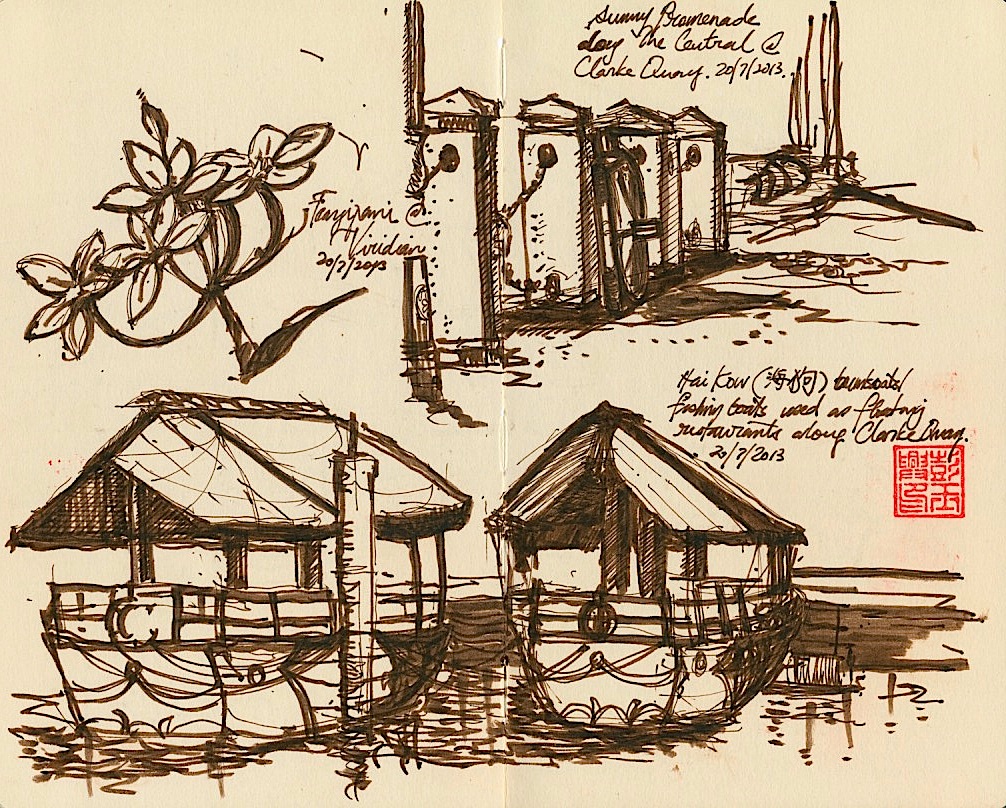
Are you clucking over to Clarke Quay?

Clarke Quay outside Central along Singapore River

Clarke Quay

I've never been a fan of CQ. The place is not exactly accessible, unless you are equipped with a car. In addition, there really isn't anything fantastic at the place. CQ is really a F&B area and the Central is really as confused and confusing as an adolescent experiencing their growth spurt and hormones.

Anyway, the reason I was there was a dinner jaunt to work off the calories. The cool evening provided a comfortable backdrop to sketch this river just before the sun was lost to the horizon.


Clarke Quay is a historical riverside quay in Singapore, located within the Singapore River Planning Area. The quay is situated upstream from the mouth of the Singapore River and Boat Quay.

Clarke Quay was named after Sir Andrew Clarke, Singapore's second Governor and Governor of the Straits Settlements from 1873 to 1875, who played a key role in positioning Singapore as the main port for the Malay states of Perak, Selangor and Sungei Ujong.

Clarke Quay is also the name of a road along the quay, part of which has since been converted into a pedestrian mall. Clarke Street, located next to Clarke Quay, was officially named in 1896, and was originally two streets known simply as East Street and West Street in north Kampong Malacca. Similar to Clarke Quay, Clarke Street has since been converted into a pedestrian mall.

The Hoklos (Hokkien) refer to Clarke Street as gi hok kong si au, meaning "behind the new Gi Hok Kongsi" (house). The new Gi Hok Kongsi was near Carpenter Street. Another Chinese reference, which only refers to the Southern bank around Read Bridge area, was cha chun tau (柴船头), meaning "jetty for boats carrying firewood". Small tongkangs carrying firewood from Indonesia berthed at this jetty. The firewood trade was primarily a Teochew enterprise.

History

The Singapore River has been the centre of trade since modern Singapore was founded in 1819. During the colonial era, Boat Quay was the commercial centre where barge lighters would transport goods upstream to warehouses at Clarke Quay.

At the height of its prosperity, dozens of bumboats jostled for mooring space beside Clarke Quay. This continued well into the later half of the 20th century. By this time, the Singapore River had also become very polluted. The government decided to relocate cargo services to a new modern facility in Pasir Panjang. The bumboats and lorries departed to their new home and Clarke Quay fell silent.

The government then cleaned up the Singapore River and its environment from 1977 to 1987. Plans were made to revamp the area and turn it into a flourishing commercial, residential and entertainment precinct. These plans took into serious consideration the historical value of Clarke Quay, making it mandatory that new buildings complement the historical character of the area and that certain old buildings be restored.

Clarke Quay Festival Village, the biggest conservation project for the Singapore River, was developed and officially opened on 10 December 1993. In later years, Clarke Quay was managed and owned by CapitaLand.

Ten years later, works were commenced to revamp the Clarke Quay area in order to give the place a better tenant mix. The development also saw major changes to the exterior and riverside areas.

Spark Architects an International Architecture practice was commissioned to redesign the shophouse facades, streetscapes and riverfront dining areas in two development phases, led by Director Stephen Pimbley. The newly redeveloped Clarke Quay consistently attracts over 2 million visitors a year and is a major social and tourist component of brand Singapore. Crucial to its success is the ingenious moderation of the micro-climate through the design of sophisticated shading and cooling systems which reduce the ambient temperature by 4 degrees celcius while enhancing the riverfront and streets with tremendous visual interests. The project won in 2007 Cityscape Architectural Review Award (Tourism, Travel & Transport – Built) and the Cityscape Asia Awards, Best Waterfront Development in 2008.

The Satay Club and a number of establishments vacated Clarke Quay to make way for new tenants. The upgraded Clarke Quay features the Zirca, The Clinic, Forbidden City by the Indochine Group and the whole development was completed in October 2006.

The Clarke Quay area at present is drastically different from the preservation/conservation effort from 1993.

Today

Presently, five blocks of restored warehouses house various restaurants and nightclubs. There are also moored Chinese junks (tongkangs) that have been refurbished into floating pubs and restaurants. The Cannery is one of the anchor tenants of the place. There are over 5 different concepts in one block. Another anchor tenant, The Arena, will be home to Singapore's First Permanent Illusion Show (starting August 2008) starring J C Sum and 'Magic Babe' Ning. The G-MAX reverse bungee, the first in Singapore, is located at the entrance which opened in November 2003. Notable restaurants and nightclubs include Hooters and Indochine. River cruises and river taxis on the Singapore River can be accessed from Clarke Quay. One of its most popular attractions is its exciting host of CQ's signature events happening once every quarter. Clark Quay has become known as a hub of Singaporean nightclubs including Zirca, and up until 2008, the Ministry of Sound.

Clarke Quay MRT Station is located within the vicinity. A new SOHO concept development cum shopping centre called The Central, above the MRT station, was completed in 2007.

In July 2012, Hong Kong lifestyle retail store G.O.D. opened a 6,000 square foot flagship store in the Quay.


An Exhibition at the Viridian Art House

Zaihan (our curator) talking shop with a guest at the gallery
I was at the opening of the inaugural USKSG exhibition at the Viridian Art House. It was all very festive and fun: a gathering of friends, good times and incredible art that is also very affordable. The exhibition continues till the 3rd of August.