Tuesday, 30 April 2013

Reflecting at the KK Women's and Children's Hospital's Lotus Pond.


Lotus Pond at Kandang Kerbau Hospital
People often ask me if I have had formal art lessons before. That question always sends my head working overtime. Honestly, I don’t know what is considered “formal art lessons”. My impression of a formal art lesson involves years of proper lessons, easels, paints and materials culminating in a certificate or diploma of some sort.

I have nothing of that sort.

What I do have that are directly linked to fine arts are art classes at the neighbourhood residents’ committee centre, art lessons in primary school and secondary school and then finally, art elective modules during my university days. Other than that, I have had no formal lessons. Not like those who have gone through years of painting and drawing lessons and have created a portfolio before they finally graduate with a piece of certifying paper with words written in some sort of manuscript ala “Black Adder”.

But what I did have, as I fondly recalled while sketching and doing some work the other day at KK Hospital’s lotus pond, are excellent teachers in those classes and electives. My art teacher during my pre-teen years at the residents’ committee was 陈淑娟老师. An alumnus of The Nanyang Academy of Fine Arts, she is a patient and humorous lady who saw my ability and threw away her syllabus to teach me watercolours instead of just crayons and oil pastels. She was the one who inspired and allowed me to believe that there can be something that I am really good at; I was a very late bloomer, academically speaking.

Much later, during my university days, I was privileged to sit under the tutelage of the late 蔡逸溪老师 – a Cultural Medallion for Art recipient. I don’t think further introductions are required.

Anyway, I was just practise-painting watercolour lotus when I recalled, fondly and with a chuckle, these little episodes in my life and quite aptly, at the namesake hospital where I was born: Kandang Kerbau Hospital:

KK Women's and Children's Hospital (abbreviation: KKH; Chinese: 竹脚妇幼医院; Malay: Hospital Wanita dan Kanak-kanak Kandang Kerbau), formerly known as "Kandang Kerbau Hospital", is the largest hospital specialising in healthcare for women and children in Singapore.[2]

From its humble beginnings as a small general hospital in 1858 to a 30-bed maternity hospital in 1924,[2] KKH has grown into an 830-bed hospital providing obstetric and gynaecology, neonatology and paediatric services. Often affectionally referred to as "KK" amongst locals, it is the birthplace of a sizeable proportion of Singaporeans, delivering over half of total newborns in the country as early as 1938.

In 1966, the hospital entered the Guinness Book of Records for delivering the highest number of newborns within a single maternity facility for that year, and it continued to hold on to this record for a full decade,[2] delivering 85% of the population.[3] 

In 1997, the hospital moved to its present site.[3] In 2003, the old premises was marked as a historical site by the National Heritage Board,[2] a tribute to an institution that has been the birthplace of over 1.2 million Singaporeans since its inception.[3]

The hospital's come from the Malay term for "buffalo shed" (kandang = shed / pen + kerbau = buffalo), reflecting the area's past link with buffalo rearing. While the hospital started as one catering to health care for women, mainly for gynaecology and obstetrics, it has since expanded its role.

First, the paediatrics department was added for the care of the babies after delivery, but over the years it expanded into a full paediatric service, treating younger patients for all kinds of illnesses up to teenage. An offshoot, the neonatology service, was then added. Thus the expanded role of the hospital warranted a renaming to KK Women's and Children's Hospital.

Over the recent years, the scope of care has expanded even more to provide holistic care to women and children patients. It strives to become the "Healthcare Leader for Women and Children", which has become its slogan. New departments were added to the hospital. Paediatric surgery was first added, followed by others such as colorectal surgery, psychiatry and orthopaedics for women with illnesses requiring expertise in those areas.

As a result of a restructuring exercise in the local healthcare scene, the hospital became a member of the Singapore Health Services on 1 April 2000.[3]


Saturday, 27 April 2013

Sketchwalk to Bishan - Ang Mo Kio Park

View of Bishan Park from Public Shelter
 Bishan - Ang Mo Kio Park
At 62 hectares, Bishan - Ang Mo Kio Park, with its ponds and bridges, colourful shrubs and lush greenery, is one of the largest and most popular parks in Singapore. Divided by Marymount Road into two plots, Pond Gardens (formerly Bishan Park 1) and River Plains (formerly Bishan Park 2), the park caters to park users of all ages. Some interesting features include three exciting playgrounds, a community garden, a vantage point on a hill that gives one a landmark view of the park, and a Riverside Gallery.

One of the highlights of the park is the stretch of Kallang River that used to run in a concrete canal but is now a naturalised, meandering river teeming with life. The result of a joint collaboration between NParks and PUB, under the latter's Active, Beautiful and Clean Waters Programme; this river brings park users closer to the water to enjoy its beauty and serenity, and to appreciate the flora and fauna that flourish in the park because of the waterway.

It may be of interest to visitors to note that the transformation of the canal into a river involved a series of bioengineering techniques and the use of a combination of natural materials such as vegetation and rocks. Civil engineering techniques were also used to stabilise the slope and control soil erosion.

The water quality in the ponds and river is maintained, without the use of chemicals, by a cleansing biotope located in Pond Gardens. It consists of carefully selected plants which filter out pollutants while absorbing nutrients from the water.

Bioengineering
The use of soil bioengineering techniques (a combination of vegetation, natural materials and civil engineering techniques) to stabilize the river banks and prevent erosion was a first for Singapore and is a new reference for soil stabilisation in the tropics, which have otherwise rarely been used or documented. In 2009, a test bed was constructed, testing about 10 different soil bioengineering techniques and a wide variety of tropical plant species along a length of 60 metres at one of the side drains in the park. Seven of these techniques were then selected for use along the main river. These include fascines, rip-rap with cuttings, geotextile wrapped soil-lifts, brush mattresses with fascines, reed rolls, planted gabions, and geotextile with plantings. The test bed was used to refine the selection of appropriate techniques and plants, as well as the most efficient and effective construction methods. Extensive systematic testing was carried out, including measuring the depth and tenacity of root development.

Cleansing biotopes  
Cleansing biotopes offer effective water treatment while maintaining a natural and beautiful environment. They consist of carefully selected plants in a filter medium which helps to cleanse the water by filtering pollutants and absorbing nutrients. Located upstream in the park, the cleansing biotope helps to maintain the water quality of the ponds without the use of chemicals.

Within the park, a new water playground was designed to increase the attractiveness and visitor enjoyment of the park. Water for this playground is supplied by cleansed pond water that has been filtered through the cleansing biotope and has undergone an ultraviolet (UV) treatment to eliminate any harmful biological contaminants without introducing any chemicals into the water.

Park features
Three new playgrounds were constructed for children to enjoy. New bridges, stepping stones in the water and a riverside gallery were also built to encourage increased interaction with water. Existing features such as the foot reflexology feature, community garden, dog run and fitness areas were refurbished to update the overall look of the park.

Biodiversity 
No wildlife was introduced to the park but the introduction of the naturalised river into the park has seen the park’s biodiversity increase by 30%. Singapore lies within the East Asian – Australasian Flyway so the park can expect to receive some special migratory bird visitors. A few surprise visitors have already been spotted including Zanzibar Red Bishop, a native to Africa, the Spotted Wood Owl, native to the jungle forest in Indonesia, Long-tailed Parakeet, native in the Andaman islands and the Orange-cheeked Waxbill, native to western and central Africa. Birds (such as the Purple Heron, Scaly-breasted Munia and the White-breasted Waterhen) that are seldom seen in a high-dense urban neighbourhood have also been spotted roosting among the new vegetation. The Malay Archipelago is one of the world’s greatest biodiversity hotspots, second only to the Amazon, and the tropical rainforest climate is home to an abundance of lush vegetation.

The restoration of the river has created a huge variety of micro-habitats which not only increase biodiversity but the resilience of species within the park, meaning their long term ability to survive is greatly improved.


Friday, 26 April 2013

March 2013 Sketchwalk at Bishan Park.

Here is the plan for this Saturday's sketchwalk:

At 9.30AM, We will meet outside the Toastbox at Junction 8 (just outside the Bishan MRT station).
We will draw around the Bishan central area. You can draw the Junction 8 shopping mall, the bus interchange there and the Bishan library with its cubby holes.

At 1030AM, let's start to fan out in the general direction of Bishan Park (See map below). Feel free to form your own small groups and form your own trails through the neighbourhood. You are encouraged to spread out and not cluster together so much. If not, everyone will be drawing the same thing. Explore freely.

From 1030 - 1230PM, take your time to explore and sketch Bishan Park which has been renovated. See the site here: Bishan Park.

At 1230AM sharp, let's meet outside the McDonald's at Bishan Park, circled in the map. We will find an open space there to view all our sketches there and end the sketchwalk.

This is just a recommended time plan. If you'd like to head to Bishan Park earlier because you are tired of drawing HDB flats, please go ahead.

If there happens to be a thunderstorm on that day, we will stick to drawing around junction 8 and the areas around.

If you are in Singapore, your are invited to join us. No joining fee or attendance. Just bring your drawing tools, paper and show up. Travel light.

Only if you are seriously lost, call Andrew at 91070735 . We will not be deviating from this mapped out route. So if you are late, please find us along this route. Thanks!:)


Saturday, 20 April 2013

It's a small commision; but it speaks volumes in its significance.

A very significant project 26 years in the making...
I received my first commission the other day: a project to reflect the venue of PassionArts at Bedok organised by the PA. It is exciting as a personal project and a personal affirmation.

When I was 12 and selecting secondary schools and programmes that I would be interested to go to after my national exams (PSLE), the then-newly implemented Art Elective Programme caught my eye. My parents, especially my mum, were supportive and encouraged me to go for it. But there was an obstacle.

Despite having helped with the illustrations of several ‘big books’ (the drawings were A3 in size), my form teacher stated that my school (i.e. herself) needs to endorse on my application and maintained matter-of-factly that I was “not good enough for the programme”.

More recently, despite being a graduate and having practiced as an interior designer and architect, I was told by the local Ministry of Education that I am “not qualified to teach art because [I am] not certified by the National Institute of Education”.

To me, it’s all right. I have already practiced as an actual designer, taught art for at least 10 years and had my works published. Now, I have at least one commissioned piece to add to my portfolio. I suppose I don’t really need their qualification for affirmation or confirmation.

Although this is a simple piece of work, its very existence speaks volumes in its significance.


Friday, 19 April 2013

Our Neighbourhoods: We Love Bedok by Urban Sketchers Singapore x Epigram

Design & Photography: Wee Editions


>> View Sample
Our Neighbourhoods: We Love Bedok

Urban Sketchers Singapore


Synopsis:


Tucked away in the East is a sleeping giant: Bedok, a paragon of the heartlands. Previously bordered by the beach, this neighbourhood was known for its scrumptious seafood. Bedok, or Bodo, as it was once called, is now the district with the largest resident population—and the oldest.
Journey with Urban Sketchers Singapore as great change sweeps eastward. Dodge through major construction at the beloved Bedok Town Centre, where Princess Theatre still stands, for the quiet of Bedok North’s songbirds. Have a dip at Bedok Swimming Complex, then replenish your energy with the famed rojak and cheng tng at Bedok South. The artists delightfully depict Bedok Reservoir too, where a certain Wall has travelled all the way from Berlin to Bedok.
Praise:
“Memory is the ultimate thing that makes a place come alive. I was a Bedok kid, and this book beautifully preserves the diversity and colour of Bedok!”
—Royston Tan, director of Old Places
ISBN: 987-981-07-5432-7

Format: Paperback

Size: 125 x 175mm

Pages: 96

Published: Apr 2013


Also in the Our Neighbourhoods Series:

We Love Tiong Bahru by Urban Sketchers Singapore

We Love Toa Payoh by Urban Sketchers Singapore


Sunday, 14 April 2013

A fresh cool day after the morning storm.

Ad hoc Plein Air at Sungei Buloh
Just felt like being amongst the greens with the air being washed afresh after the morning storm.


Bishan Columbarium 广惠肇碧山亭

Pavilion at Bishan Columbarium
Went with my family for ancestral prayers earlier this month: my paternal grandparents' remains are placed here. While hanging around at the place in between the prayers, I did a quick sketch of the picture postcard setting of the pavilion there and then filled it with colour later.
 
Kwong Wai Siew Peck San Theng (广惠肇碧山亭) was a cemetery in Singapore that was established in 1870 by immigrants largely from the three prefectures of Kwong Chow Fu (广州府), Wai Chow Fu (惠州府) and Siew Heng Fu (肇庆府) in Guangdong Province, China. It was originally solely for the Cantonese community, but within a century, Peck San Theng (PST) became one of the biggest Chinese cemeteries in Singapore, holding more than 100,000 graves over 384 acres (1.55 km2) of land.

In 1979, the Singapore government decided to acquire all its land to create the present Bishan New Town. Many graves were exhumed and remains cremated during the 1980s. To enable Peck San Theng to continue with its tradition, the government leased 8 acres (32,000 m2) of land to Peck San Theng for accommodating an office block, a Memorial, two temples and a columbarium. The columbarium houses some 100,000 niches which are available to the to public irrespective of race, language and religion since 1980. It was and will continue to be a place for ancestral worship in Singapore. Peck San Theng is currently managed by a federation of sixteen clans of the Cantonese community in Singapore.


Thursday, 4 April 2013

"We've decided to include two of your sketches..." ~ Epigram

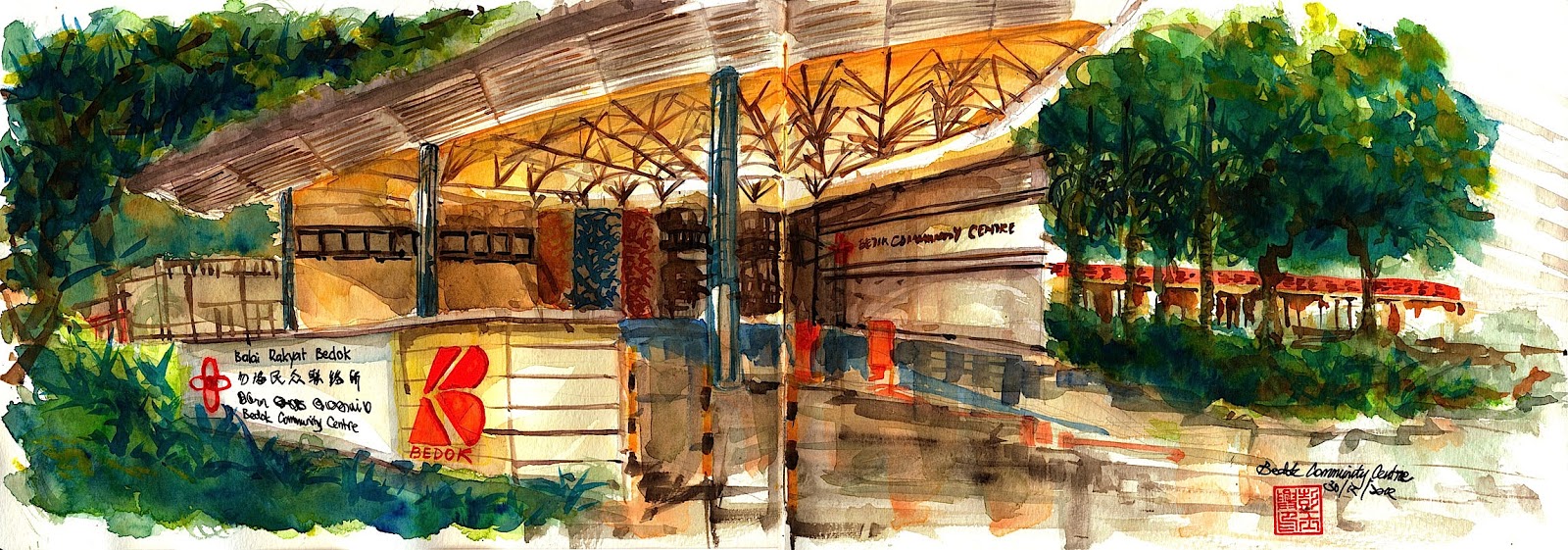
Just received news that TWO of my paintings from the Bedok sketchwalk has been selected for publication in a commemorative book by Epigram for the estate.

Tres-tres excite!

The sports area in Bedok estate.
Bedok Community Centre


Urban Sketchers Singapore featured on the Singapore American magazine.

The expatriate publication, Singapore American has published their April issue and USKSG has a full-page feature  in their arts section.


Wednesday, 27 March 2013

March 2013 sketchwalk at Gillman Barracks.


Hi all, sketchwalk this saturday March 30th, will be at Gillman Barracks. This is a former military camp which has been converted into a place for art galleries and eateries. I've not been there myself, but sketchers who have been there recommend it.

The closest MRT station is Labrador Park (Circle Line Station CC27.) From there, it is just a short walk up along Alexandra Rd to the Gillman Barracks at 9 Lock Rd. A clearer direction and map can be found here.

We will gather at Gillman Barracks (9 Lock Rd) at 930am to start our sketchwalk. So please have your breakfast before coming. Sketchwalk will be free and easy so you can draw whatever catches your interest there, be it buildings or bugs. At 12.30pm, please return to the starting point (9 Lock Rd) where we will gather, look at everyone's drawings and take photo!

Everyone in Singapore is invited. And if this is your first time, we encourage you to travel light as you may have to do some walking. Bring a hat in case it gets hot. Bring a portable/collapsible stool to sit more comfortably. All levels of drawing skills are welcome, so don't be shy. You are also free to use any drawing tools and technique you wish. In fact, this is a good time to try techniques and art tools you've never tried before because it is all just for fun!

The place is relatively easy to find and it will be easy to spot the sketchers. But if you are seriously lost, you may call Andrew at 91070735. (But please call only if you are seriously lost or else he will have to keep answering his phone while sketching, which is a massive inconvenience. Thanks!)

See you all there!

PS: There is a giveaway contest for this sketchwalk here : http://www.urbansketchers-singapore.blogspot.sg/2013/03/giveaway-contest-for-gillman-barracks.html


Sunday, 24 March 2013

A Little Sketchwalk at the Woodlands Regional Library


View of the Library from the Cafe Galilee at the Woodlands Library
Love the little mushroom backrest at the kiddies reading area.
Reading under tree amongst the mushrooms in the glen on the 4th flour of the library.
Discover a place where learning and creativity meet, at Woodlands Regional Library! Art Fresco is an arts programme consisting of a monthly variety of workshops, talks and performances, to bring you a whole new canvas of artistic experiences through appreciation and hands-on activities. This programme is jointly initiated by National Library Board and National Arts Council.

Enjoy a mini exhibition of beautiful pieces that exhibit snippets of life in Woodlands. Drawn by members of USKSG with a passion for sketching, these pieces aim to capture familiar spaces and buildings, and connect you to fresh perspectives of everyday Singapore.


Monday, 18 March 2013

Art Fresco @Woodlands Regional Library

Discover a place where learning and creativity meet, at Woodlands Regional Library! Art Fresco is an arts programme consisting of a monthly variety of workshops, talks and performances, to bring you a whole new canvas of artistic experiences through appreciation and hands-on activities. This programme is jointly initiated by National Library Board and National Arts Council.

There will be a special exhibition and sketch walk held in collaboration with the Urban Sketchers Singapore at the Woodlands Regional Library on 24 March (Sun) from 2 - 5pm.

The activity is held to encourage sketching amongst the heart-landers and as a means to record our memories. Selected Urban Sketchers Singapore's artwork will also be on display at the special exhibition during the 24 March event.


Do drop by and experience how memories and places can be archived and sustained using visual and graphic means.


Sunday, 17 March 2013

Woodlands Town Garden

Woodlands Town Garden Lake overlooking the bridge and pavilions.
The sketchwalk during the afternoon on the day before was too hot to capture the mood in the garden. I woke up early to go back and caught the place the way I remembered it: Quiet. Peaceful. Serene. Comforting.

I stayed in a nearby rented apartmentduring my university days in the early noughties. This was my favourite hauntfor a quiet scenic sanctuary. I love the peaceful serenity the place affordsand I’m glad that it still does.


Saturday, 16 March 2013

Starbucks at Woodlands Civic Centre.

Starbucks at Woodlands Civic Centre.
After a whole day of sketching at VivoCity and Woodlands (that's from South to North), the sketch group went for dinner together and I finally chilled out at this spot after some shopping.


Woodlands Town Garden


Coconut palms over the lake.
Pavilions dotting the park. A respite from the tropical heat.

If you are around Woodlands New Town, drop by Woodlands Town Park and enjoy the greenery and ambience the park has to offer. Look out for the design of the park amenities that has both Malay and Chinese elements. Sungei Mandai Kecil, a river that flows through the park, was also integrated in the design of the park. Part of this river that flows into the park was enlarged into a lake, irregularly-shaped for a natural look.


RSS Intrepid sails into Vivocity

The RSS Intrepid docked at VivoCity from 15 to 17 March.
The Republic of Singapore Navy (RSN) brought its Formidable-class stealth frigate RSS Intrepid, together with a Sikorsky S-70B naval helicopter, to VivoCity Promenade for the first time. This is in conjunction with Navy@Vivo, an event held from March 15 to 17 as part of the RSN's community outreach effort. Navy@Vivo is open to the public from 4pm on March 15 till 9pm on March 17.


Wednesday, 13 March 2013

Hong Wen School at Towner Road

The current site of Hong Wen School is the field of my alma mater, May Primary School.
This SAP school is located at the former site of my alma mater. Its exact compound is just the area of what used to be my school field.

I remember my primary school days, studying in May Primary School. I started in the school when it was still May North Primary School. I was enrolled into Primary 1B and very fortunate to be so because my form and English teacher was Miss Gomez: an excellent language teacher who was my first exposure to formal English.

She inspired and taught me the importance of diction and elocution. I will always remember her. I remembered that she was very proud of me when I graduated from Primary 6 as a member of the Prefectorial Board. She even asked me to give a stern warning to a Primary 3 boy when I asked her for an autograph.

Yes, I still have that autograph.

Ad Hoc At Woodlands...

Hey folks, there will be a special event and sketch walk organised by NAC (National Arts Council) and Woodlands Regional Library on 24 March (Sun) - will update more on that later.

In preparation of this collaborative event, there will be an ad-hoc sketch walk on 16 March (Sat) 3-6pm at Woodlands Regional Library to encourage the residents there to explore the neighbourhood estate through sketching, and everyone is welcome! It would be best if sketchers do their work on loose sheets, such that they could have their artwork displayed in a special exhibition during the 24 March event.

This will be a long-term community project by NAC and NLB (National Library Board), and hope our Urban Sketchers Singapore group could be a part of it too.

For this ad-hoc, the details are:

Venue: Woodlands Regional Library main entrance
Date: 16 March
Time: 3pm to 6pm

And do keep your 24 March free too!

Hope everyone could join in and make this a fun project!


Saturday, 9 March 2013

Ad Hoc Sketchwalk at Dhoby Ghaut Green

Remember the Kallang Wave
Sketchers being sketched...
Dhoby Ghaut Green was identified as an interim park in URA's Public Space and Urban Waterfront Master Plan 2003, and conceived as a "City Room" for community gathering within the city and officially launch in 24 Oct 2009

The special locality of this park and the diversity of the user groups in the vicinity create opportunities to provide a focal point for Art & Culture, Concerts & Performances and community activities, or just a resting place for users to appreciate the surrounding park and urban environment. The site is highly accessible to people from all over the island as it is at the confluence of 3 MRT lines, North-South line, North-East line and Circle line.
Sculptural open-air amphitheatre at central space is the landmark of this park. It serves as a showpiece for the Architectural and Urban Design Excellence demonstration project and a performance venue to encourage public participation and enjoyment of the open space. Natural lines of a rattan basket inspired the design comprising interweaving aluminum screens. Night lighting will make it glow like a lantern. They also allow partial sun shading to the users. In addition, it also allow for natural through-ventilation, enable air to circulate freely through the structure. At the lower part of the amphitheatre is the performance stage with basic stage lightings. Multi-purpose rooms are available at the backstage for preparations before performances.
The green lawn and the beautiful landscape create a contrast against the architecture of the buildings in the area. The large canopies of the Rain Trees and Yellow Flame along the walk way provide good shade for the park users and the passers-by of this area.
The gravel area at western parcel is densely shaded from existing trees, providing a tranquil environment that contrasts with the bustle of the surrounding cityscape. This serves as a platform for handicraft street bazaars and busker performances.
This park provides adequate gathering spaces in the form of plazas for mass dancing and performances. An open field on the eastern end on the site is designed to allow for light recreational sports and other community events. Conveniently located on the northern side of the field between both exits of the Dhoby Ghaut MRT station is a cafe offering indoor and alfresco dining experiences.


Ad Hoc Sketchwalk at Dhoby Ghaut Green: The MacDonald House


The MacDonald House
The Historical Significance of The MacDonald House (extracted from the Straits Times, 11 March 1965)

The bombing of MacDonald House took place on 10 March 1965, when Indonesian saboteurs Harun Said and Osman Hj Mohd Ali planted a bomb near the building’s lift (The Straits Times, 11 Mar 1965, p. 1). The resulting detonation killed three people and injured 33 others.

The MacDonald House bombing took place during the period called Konfrontasi, meaning “Confrontation” in Indonesia. During that period, Indonesia under President Sukarno, used military force to engage in acts of sabotage and terrorism as part of a policy of intimidation. Sukarno opposed the formation of Malaysia, comprising a federation of Malaya, Singapore and the British colonies in Northern Borneo. He saw the Federation as a cover for the continuation of colonial power in the region (Sodhy, 1988, p. 112-114). On 23 September 1963, he announced that Indonesia would ganyang meaning “crush” Malaysia.

Singapore was especially exposed to the threat of terrorism due to its proximity to the Indonesian Riau Islands. The campaign to demoralise the Singapore population resulted in some 40 terrorist bombings by mid-1965. The Riau Islands was the headquarters for the military training of men recruited from Singapore and Indonesia. These men were under the direction of the former assistant Indonesian naval attaché to Singapore, Lieutenant Bambang Partono. From Pulau Sekupang, Indonesia planned to land battalions in Singapore, Johor and Kelantan to engage in acts of sabotage (The Straits Times, 19 Dec 1963, p. 1).

What happened
The two Indonesian bombers had come to Singapore earlier the same day at about 11:00 am (The Straits Times, 12 Mar 1965, p. 7). After lunch, they proceeded to MacDonald House where they planted bundles of explosives along the steps leading up to the first floor. After lighting the bomb fuse, they left the building by 3:00 pm and boarded a bus. A witness saw a Malayan Airways canvas bag on the mezzanine floor of the building emitting smoke and a hissing noise.

At 3:07 pm, the detonation set off an explosion that ripped off a lift door. Fortunately, the inner walls of the mezzanine floor were able to withstand the full force of the blast. However, three innocent bystanders on the other side of this wall were badly affected. Elizabeth (Suzie) Choo Kay Hoi and Juliet Goh Hwee Kuang were both killed instantly and buried by the rubble (The Straits Times, 12 Mar 1965, p. 9). A third victim, Mohamed Yasin bin Kesit, a driver for the Malaya Borneo Building Society, fell into a coma and died a few days later. The explosion also injured 33 others (The Straits Times, 13 Mar 1965, p. 1).

Impact of the bombing
Furthermore, the blast shattered windows within 91.4m of the MacDonald House building and also damaged almost every car outside the building. The bank closed for business only seven minutes before the explosion and 150 employees were closing their accounts at the time. Witnesses recounted a sudden flash followed by a bang. The explosion was powerful enough to destroy pillars and expose the steel reinforcements within. Later investigations showed that 20lb to 25lb (9kg to 11kg) of nitroglycerine were used (Sinnadurai, 1990, p. 518).

The explosion also affected the offices of the Australian High Commission located in the same building. Heavy wooden doors were wrenched from their hinges, landing 30ft (9.1m) away along the passageway. The impact also created widespread damage to the Cycle and Carriage showroom across the road from MacDonald House. The flying glass splinters injured two mechanics and damaged cars in the showroom (The Straits Times, 7 Jul 1990, p. 29).

At 3:30 pm, the reserve unit arrived and traffic police diverted traffic along Penang Road and Tank Road. Soon after, the British Army's bomb disposal squad arrived at the scene. Of the 33 people injured, several were warded at the General Hospital, including Samin bin Almari, Jamil bin Kassim, Tan Bee Geck, Kupusamy, Peter Ng, Ramasamy Marimuthu, and Zainal bin Kassim. The rest of the injured people received outpatient treatment (The Straits Times, 11 Mar 1965, p. 1).

At 6:15 pm, Minister for Health Yong Nyuk Lin visited the hospital to meet the bomb victims personally. He condemned the attack as a "senseless act of cruelty that will not solve any political problem" and asserted the need to weed out terrorists. He also noted that the explosion was not the first in Singapore as there were other incidents (The Straits Times, 11 Mar 1965, p. 1).

Saboteurs caught
Three days after the explosion, the two Indonesian saboteurs responsible for the MacDonald House bombing were caught while they were trying to escape from Singapore. They were rescued at sea by a boatman who saw them clinging to a piece of wood. At the time, they were not wearing military uniforms and had no identification papers. They were later taken on board by a marine police boat. At 1:25 pm on the same day, the police interviewed the saboteurs and  obtained details of their role in the MacDonald House bombing (The Straits Times, 7 Oct 1965, p. 5).

On 20 October 1965, Harun Said and Osman Hj Mohd Ali were convicted by the High Court of Singapore under the Penal Code for the murder of three civilians and sentenced to death. Their appeals to the Federal Court of Malaysia were dismissed on 5 October 1966. Both were hanged at dawn on 17 October 1968 and their corpses sent home to Jakarta that same day (The Straits Times, 18 Oct 1968, p. 14). About 10,000 Indonesians gathered at the airport to give them a hero’s welcome. Chief Admiral Muljadi received the bodies at the airport with a contingent of soldiers, marines and students. Indonesian flags were flown at half-mast for two days. The commandos were later buried with full military honours and decorations.

Outcome
In Jakarta, the execution of the two Indonesian commandos incited public anger. As a result, a well-organised band of 400 students sacked the Singapore embassy in Indonesia as well as the residences of Singapore diplomats. These students were upset as they felt that the Indonesian soldiers had only carried out the orders of the government of former President Sukarno who stepped down in 1966. The students were reported to have used bamboo staves and smashed furniture and windows. The attacks took less than an hour, after which the mob went to the security headquarters building where the bodies of the two executed commandos were lying in state (The Straits Times, 18 Oct 1968, p. 1).


Tuesday, 12 February 2013

I dreamed of Phuket Part X

Morning sketch. View from outside my room in Casa Jip, Patong, Phuket. I've always loved the power cables running along and outlining the city line!
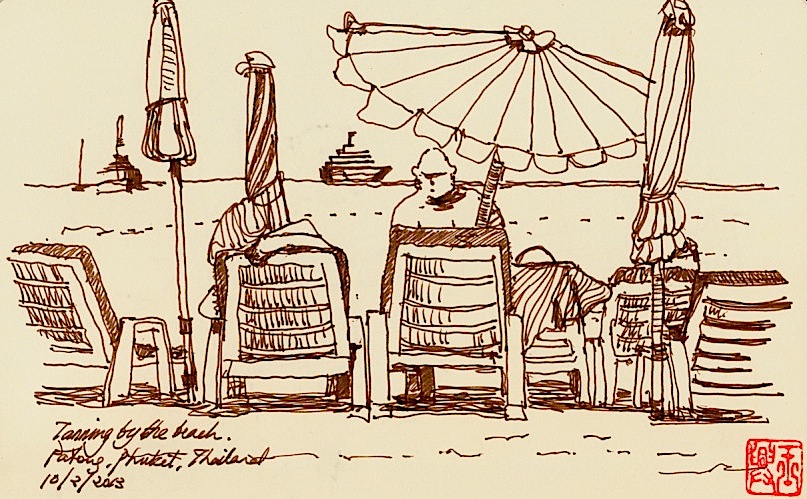
Fellow sunbathers... good day.
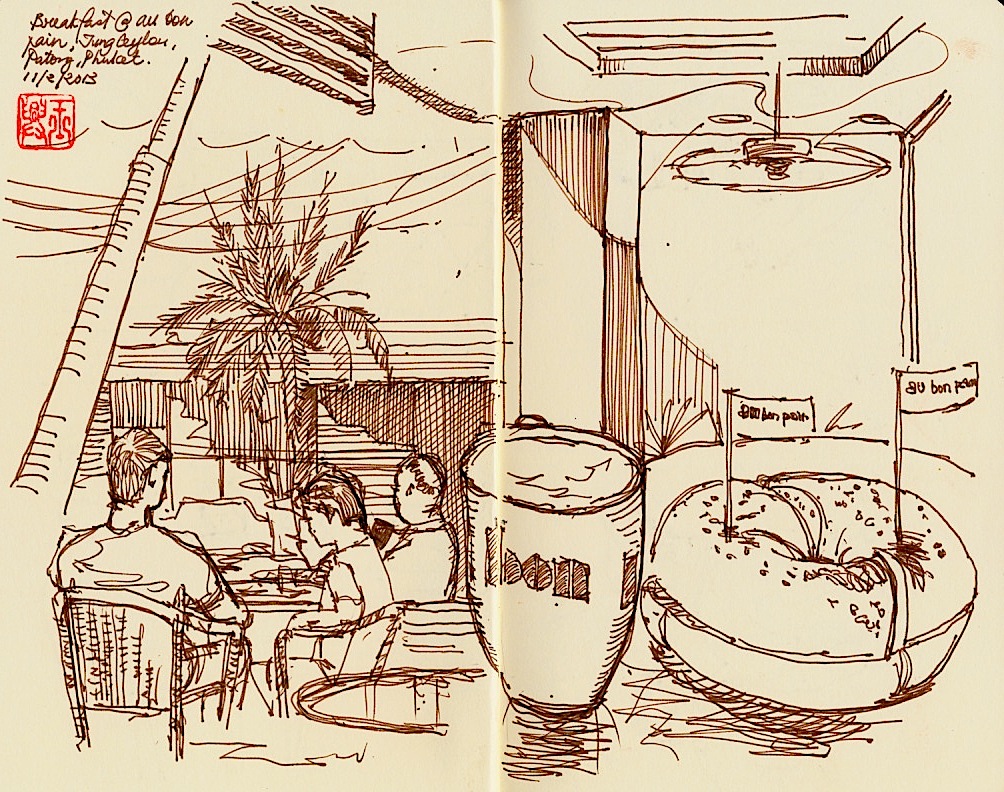
Always love Au Bon Pain.
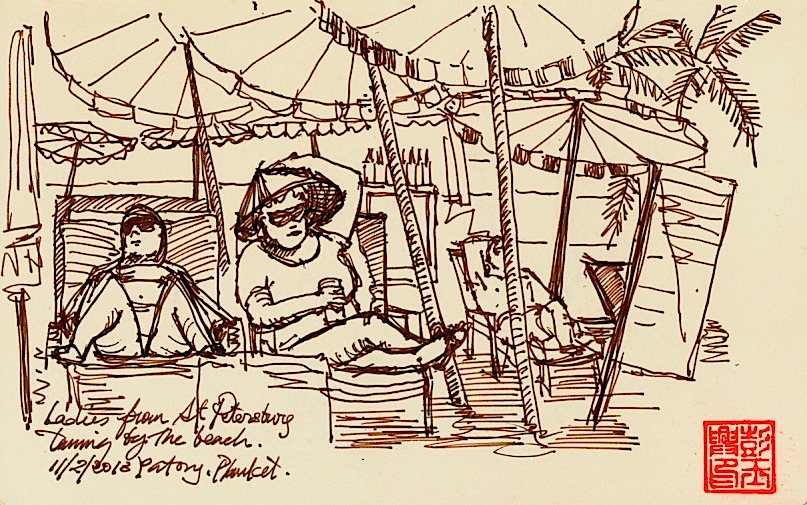
These two Russian ladies from St Petersburg came over to look at my sketch and we had a good laugh. She insists that she's smaller (i.e. slimmer) than depicted in the picture and is drinking milk. I agreed: it's milk made from barley, wheat and hops.
This trip in February over the Chinese New Year period marks my tenth trip to Phuket. My first trip there was very memorable for various reasons:
  • It was my first time to Phuket;
  • It was my first flight on a budget airline (AirAsia);
  • It was my first overseas trip with Terrel;
  • I came back just days before the Boxing Day Tsunami.
Yes, you read the last point right, I was there that year - 2004.

I love the place - the locals are so warm and friendly. The culture is so free and easy, live and let live. AND I have yet to find a place where you can go from beach to shops to shopping mall all within minutes of each other.

Yes, I love Phuket. Don't be surprise if one day, I should retire on that island with my own ocean view bungalow while running a B&B-cum-bar.

Saturday, 26 January 2013

Setchwalk from Wessex to Portdown

Vimy House along Woking Road.

Wessex Village Square
Although the island Republic of Singapore has been submitted to a systematic territorial revolution since the 1960s, some of its urban heritage has been preserved. This is the case with Wessex Estate, a quiet residential neighbourhood located in the low hills extending on the western flank of the central urban area. Made up of less than a dozen bungalows and 26 small blocks of flats, Wessex Estate is of no particular architectural interest, but it does represent a heritage through the names borne by the blocks of flats.

Clearly printed on the façades of the 26 blocks of flats, these names all refer to military feats of British history. The study locates and briefly describes these events, several of which took place on European fronts, as far back as the early 18th century (such as Ramilies, Blenheim), others throughout the British Empire, starting from the middle of the same century (such as Plassey, Quebec, Khartoum, Pegu).

Built just prior to or just following WWII, it seems that the flats housed non-commissioned British officers during the Malayan Emergency (1948–1960). Their names refer to battles or theatres of war in all of which a given British regiment, the 67th or South Hampshire Regiment, might have been involved. Whatever the case, it remains somewhat remarkable that so many reminders of the colonial past, even a good number with "no natural connection" to Singapore, have remained prominent in this city-state otherwise apparently prone to sever "colonial apron strings".


Friday, 25 January 2013

JANUARY 2013 SKETCHWALK


Sketch by Favian
Hi everyone,

The first sketchwalk of the year will be along Portsdown Rd (Wessex Estate area). We will meet 930AM, 26 JAN, Saturday, at Fusionopolis' Ya Kun cafe. You may take the circle line and drop off at One North Station, which is below Fusionopolis itself. Take the escalator up to the first floor and you will see Ya Kun cafe. 

Have your kaya toast breakfast there earlier, if you like. At 9.30 sharp, we will start moving off along Portsdown Road (see map). You may stop to draw anything that catches your interest along the way. But keep moving up the road, pacing yourself, until you reach Colbar, a famous eatery. There will be signs that will point to the eatery when you near it. There is a cluster of cafes there. Feel free to take any detours you like along the way. But at 12.30pm, please be present at Colbar for our "show and tell" gathering and possible lunch there.

If you are late, just head up Portsdown Road and you will find us along the way. It a long walk so travel light. But it's a nice walk. See you there!


Wednesday, 16 January 2013

In Pursuit of Life and Liberty Coffee!

Liberty Coffee at 131 Rangoon Road: for a satisfying and mesmerising cuppa with pastry selections that is matchmade in heaven in an equally wonderful environment.
Quite literally, it had been a chase. I had originally planned Liberty Coffee as part of my December Cafe Skecthwalk (Part 1). That was when I learnt that they are wholesalers and retailers of coffee beans rather than a cafe and they consider the occasions when they do open for drinking coffee as 'coffee-tasting' sessions. It is only on certain adhoc, random days when they do open for such an event. They do announce a few days in advance for a one-day only affair. So really, they are like the mayflies in the coffee-drinking circle. Missed the day and that's it - you have to wait for the next cycle.

However, the wait is certainly worth it. I noted that they are opened today make a trip down after work for an experience. I was fortunate to find a seat at a vantage point (to eat, to observe, to sketch). What was even more fortunate was that Pauline (the lady of the house) had prepared a wonderful pastry concoction of gula Melaka pandan chiffon to go with the latte I ordered from the master of the house, Terence.

The pair is a matchmade in heaven (referring to the food, of course). The cafe latte, made with espresso from the Speakeasy Houseblend is extracted just right - nutty, smoky, chocolatey with just the right amount of sweet from the espresso and the perfectly steamed milk served in a fancy latte art. Meanwhile, the chiffon is delectable with just the right amount of sweet to complement the coffee that was served together.

The environment is a cosy, homely hustling and bustling coffee place. On opening days, arrive at the right time (i.e off peak hours if it happens to be a weekday) for a seat as well as a satisfying selection of pastry to go along with your brew or espresso. The place will not disappoint.


Tuesday, 15 January 2013

《青花瓷》: My Affections for Blue+White aka An affair with Royalty (of the Copenhagen type).

TWG loose leaf tea and Royal Copenhagen Blue Flower Curved Tea Cup Saucer
I have always loved blue+white porcelain. "Blue and white wares" (Chinese: 青花; pinyin: qīng-huā; literally "Blue flowers") designate white pottery and porcelain decorated under the glaze with a blue pigment, generally cobalt oxide. The decoration is commonly applied by hand, by stencilling or by transfer-printing, though other methods of application have also been used.

One of favourite range is from Royal Copenhagen. I got a few pieces of their wares when I started working and had hoped to own a whole tea service when I get my own place. However, they pulled out of Singapore before I got the chance to do that. Fortunately, I still have a set of mugs and tea cup and saucer, plus a couple of their crystal glasswares.

Tea, anyone?

Sunday, 13 January 2013

A Little Soba Fix

Dinner at Shimbashi Soba
Soba (そば or 蕎麦?) is the Japanese name for buckwheat. It is synonymous with a type of thin noodle made from buckwheat flour, and in Japan can refer to any thin noodle (unlike thick wheat noodles, known as udon). Soba noodles are served either chilled with a dipping sauce, or in hot broth as a noodle soup. It takes three months for buckwheat to be ready for harvest, so it can be harvested four times a year, mainly in spring, summer, and autumn. In Japan, buckwheat is produced mainly in Hokkaido.[1] Soba that is made with newly harvested buckwheat is called "shin-soba". It is sweeter and more flavorful than regular soba.

I love the soba served at Shimbashi for two reasons: the freshness and the texture. Their soba is made fresh daily at the premises and has a wonderful chewy texture that is just right. So, whenever I feel like a soba fix, I'll find myself here