Saturday, 23 August 2014

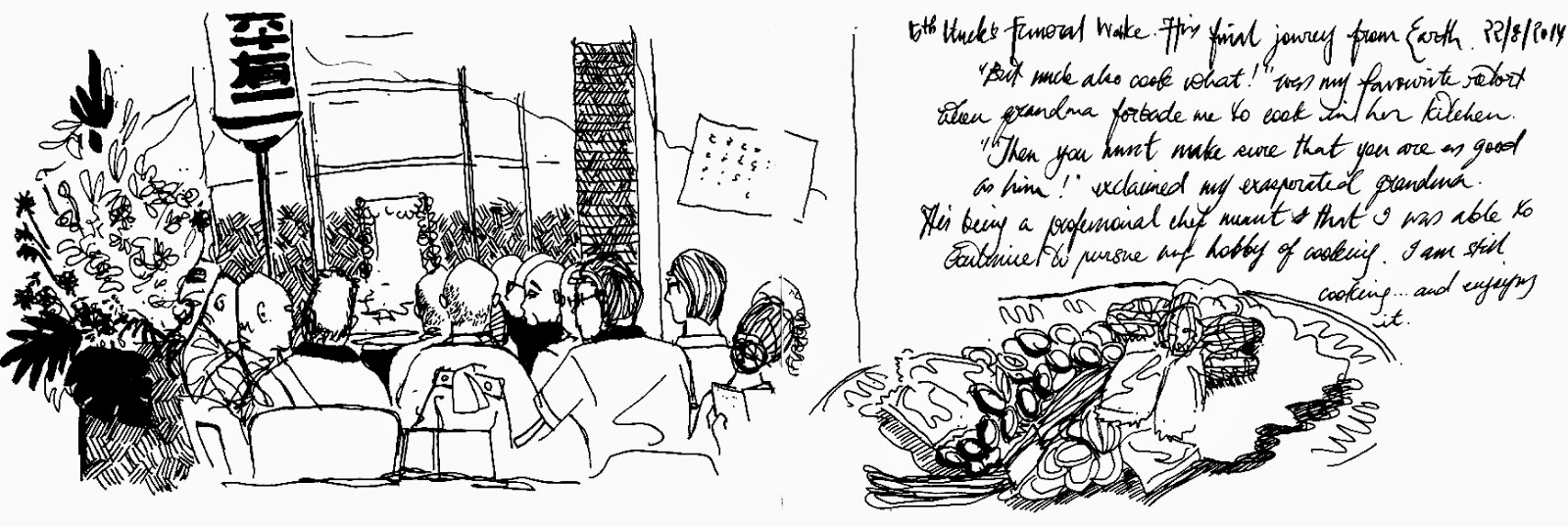
Fifth uncle’s final journey.


Buddhist monks leading a small group of followers in a chant at the wake.
Platinum Preppy pen
with de Atramentis ink on Stillman and Birn Beta Hardbound.
“But uncle also cook what!” was my favourite retort when grandma fretted and forbade me from her kitchen.

“Then you must make sure that you are as good as he is!” exclaimed my exasperated grandma. Yes, grandma is a fiery spirit, just so you know where I get mine. She is an honorary Nyonya, that one, but so is uncle, where fiery spirits go, literally. So I guess it runs in the family.

My uncle has cheffed with a slew of established restaurants under his belt, a couple that stuck in my memory include:
  • Szechuan Court and Canton Garden at Raffles City, when the hotels were still under Westin. I believe only Szechuan Court is around and has expanded into Szechuan Kitchen as well. Afterall, Szechuan and Canton functioned with the same kitchen anyway.
My uncle being a professional chef meant that I was able to pursue my hobby of cooking. Looking back at this memory, he was, in a way, as a hyperbole of some sort, part of the impetus that nourished the Feminist in me, together with my grandma, of course. Because, if a man (my uncle) can be a master in a kitchen and a woman (my grandma) can head a household, then there is no such thing as designated gender roles.

And I am still enjoying my hobby of cooking and baking and running my own household. 


Sunday, 17 August 2014

*Balek ke Bali...*

I travelled to Bali for a two-week holiday in 2007. My first time on the island then, I decided to arrange for an airport transfer. The guide who brought me to my hotel subsequently helped me with my itinerary. It helped that I had a basic list of things to do and places to visit. Also, the fact that I had fourteen days meant that my schedule and itinerary could be flexible.

I made plans for: 
  • Jengala Keramik – paint a pot 
  • White water rafting 
  • Balinese cooking lesson

The guide, knowing my interest in cultural and historical places of interest, helped me make plans for visits to:
  • Ulu Watu
  • Tanah Lot
  • Besakhi Mother Temple
  • Goa Gajah
  • Mount Agung
With so much time in hand, I had time to just drop by nature spots for a visit:
  • Waterfall
  • Lovina volcanic beach
  • Ubud market (fresh strawberries at S$5/kg and vanilla beans on the cheap)
  • Agro-tourism plantations, where I learnt to dislike Balinese coffee, made of over roasted, tasteless Robusta beans.

The good thing about travelling with a guide is that they are able to plan your travels and make the most out of the day, traversing the island in a very efficient manner. Being unfamiliar with the island may mean crossing the island in haphazard directions, or arriving at a place too early, too late or too crowded. Unless of course, you have equipped yourself with an armful of travel books and has set a well-planned itinerary weeks before. Otherwise, it may be wise to go with a guide, which is very affordable and always very friendly: it’s the Balinese temperament.

It was with this prior experience that I know exactly where I want to go and what I want to do on my second visit over the long weekend just past, when I *returned to Bali...*


Waiting for my flight at Changi Airport and hating the strict enforcement of carry-on luggage weight-limit.
Yup, that's my flight!


Falling asleep on the 3-hour flight...
First night's dinner ; a whole fish set dinner for S$7!


Breakfast: we couldn't find anything local...


Souvenir from Jenggala Keramik of my first trip to Bali.
Day 1: I made myself a self-painted ceramic plate at Jenggala Keramik the last time I was there. In my impression, it took three days to deliver, so I thought the place should be first on my itinerary. Unfortunately, they’ve changed their policy to four to five days and the fact that my visit was over a weekend meant that it was impossible to do this again this time around. Thus, I settled for one of their well-made plates and a watercolour sketch of their place.

(Note to self: Next time, I should make a 6 day stay and not over a weekend to get this done.)


The headquarters and showroom of Jenggala Keramik at Jimbaran.
Lunch at Nusa Dua, along the way to Uluwatu
Lunch was next. It was an exploratory trip on the way to Ulu Watu and it was settled at this restaurant at Nusa Dua. Food is always affordable at Bali. An overwhelming meal at a restaurant is almost always just a few dollars in the teens. Yup, it’s THAT affordable.
The Jeroan (Holy of Holies) at Pura Uluwatu
Uluwatu Temple, or Pura Luhur Uluwatu, one of six key temples believed to be Bali's spiritual pillars, is renowned for its magnificent location, perched on top of a steep cliff approximately 70 metres above sea level. This temple also shares the splendid sunset backdrops as that of Tanah Lot Temple, another important sea temple located in the island's western shores.

Pura Luhur Uluwatu is definitely one of the top places on the island to go to for sunset delights, with direct views overlooking the beautiful Indian Ocean and daily Kecak dance performances. Balinese architecture, traditionally-designed gateways, and ancient sculptures add to Uluwatu Temple's appeal.

Without a doubt, what makes Uluwatu Temple spectacular is its cliff-top setting at the edge of a plateau 250 feet above the waves of the Indian Ocean. 'Ulu' means the ‘top’ or the ‘tip’ and 'watu' means a ‘stone’ or a ‘rock’ in Balinese. Several archaeological remains found here prove the temple to be of megalithic origin, dating back to around the 10th century. There are two entrances to Uluwatu Temple, from the south and the north.
The trail along the fortified cliffs of Uluwatu.
A small forest lies at the front and hundreds of monkeys dwell here. They are believed to guard the temple from bad influences. In reality though, be very wary of them: they are known to grab anything attractive to them from you. Concrete walls on the cliff side fortify the serpentine pathway to the temple. It takes about an hour to get from one end to another as there are several fenced points along the way to stop. The views from the bottom of the water surging up against rocks and the ocean horizon are remarkable.

The Balinese Hindus believe that the three divine powers of Brahma, Vishnu, and Siva become one here. That belief results in making Uluwatu Temple a place of worship of Siva Rudra, the Balinese Hindu deity of all elements and aspects of life in the universe. Pura Uluwatu is also dedicated to protect Bali from evil sea spirits.
The Kecak performance (about S$10/entry) at sunset.
The temple ground is also where the Kecak Balinese dance and music drama, developed in the 1930s in Bali, is performed. Done primarily by men, it is also known as the Ramayana Monkey Chant. The piece, performed by a circle of 150 or more performers wearing checked cloth around their waists, percussively chanting "cak" and throwing up their arms, depicts a battle from the Ramayana. The monkey-like Vanara helped Prince Rama fight the evil King Ravana. Kecak has roots in sanghyang, a trance-inducing exorcism dance.


Breakfast by the padi fields along the way to Tanah Lot.
P.S. The food may induce instant diabete. Proceed with caution.

Day 2: Tanah Lot is a rock formation off the Indonesian island of Bali. It is home of a pilgrimage temple, the Pura Tanah Lot

The temple is isolated from the mainland during hightide.
Tanah Lot is claimed to be the work of the 16th-century Priest, Dang Hyang Nirartha. During his travels along the south coast he saw the rock-island's beautiful setting and rested there. Some fishermen saw him, and bought him gifts. Nirartha then spent the night on the little island. Later he spoke to the fishermen and told them to build a shrine on the rock for he felt it to be a holy place to worship the Balinese sea gods.[3]

The Tanah Lot temple was built and has been a part of Balinese mythology for centuries. The temple is one of seven sea temples around the Balinese coast. Each of the sea temples were established within eyesight of the next to form a chain along the south-western coast. However, the temple had significant Hindu influence.

At the base of the rocky island, poisonous sea snakes are believed to guard the temple from evil spirits and intruders. A giant snake purportedly protects the temple, which was created from Nirartha's towel when he established the island.
The area leading to Tanah Lot is highly commercialized and people are required to pay to enter the area.

A quieter spot on the same grounds as Pura Tanah Lot. This temple gets its name from the unique rock formation on the cliff which it stands.
A five-minute walk from Pura Tanah Lot, is the quieter Pura Batu Bolong. As the name implies, the temple is located above the black rock of Senggigi Beach which has a hole carved by the waves. With its position that juts into the sea, of course, this temple has its own atmosphere of beauty: quiet, serene, solitude.
Lunch at Waroeng Made Becik upon arrival at Ubud. The music, the breeze, the palms, the lull.
Known as the "Mother Temple" in Bali, Pura Besakih is situated 3,000 feet up the slopes of Mount Agung in East Bali. Pura Besakih, considered the most important Hindu temple in Bali, is actually a complex of 23 separate temples that can be explored by tourists. The Pura Besakih temples are thought to date back to the 14th century, however some locals date them back as early as the 10th century.

Captivating view of the multilevel temple complex that is Besakih.
Constructed on six different levels, Pura Penataran Agung is the epicenter of the temple district. White banners flying around Pura Penataran Agung denote the temple's dedication to Shiva. Pura Besakih, famous for allowing Hindu followers from any caste to worship, draws worshipers from all over the world.

The numerous scams and excessive hassle around Pura Besakih ruin the entire experience for many tourists. The temple is sadly exploited as a way to shake tourists down for money. Some tips for avoiding scams around the temple complex:
  • Guides are not necessary: Locals will tell you that certain temples are "closed" or that you must hire a guide to see "sacred" parts of the temple. Nearly all of the Pura Besakih temple precinct can be explored independently. Unofficial guides may demand a tip to continue halfway through your tour.
  • Bring your own sarong: Proper dress is expected inside of Hindu temples; men must cover their legs with a sarong. Sarongs can be rented at the entrance of each temple, however purchasing your own in Ubud is a better idea.
  • Do not overdo donations and do not feel obilgated: Upon entering each temple, you will be pressured to give a donation. A logbook of previous guests will show exorbitant amounts of $10 - $40. A typical donation to other Hindu temples in Bali is typically around $1.
  • Expect inflated prices: Food, drinks, and souvenirs around the temples are outrageously priced - wait until you return to Ubud to enjoy delicious Indonesian food.
Dinner at Cafe Wayan, Ubud: it's like dining in a garden.

Woke up to the call of nature: country stay means morning calls by roosters are included free of charge. But the Balinese garden view glistening with morning dew makes it worth the while.
Tegalalang: this beautiful, serene iconic symbol of Balinese rice agriculture is now used as a spot to cultivate a different type of crop: tourist commercialism.
Day 3: Tegalalang Rice Terraces in Ubud is famous for its beautiful scenes of rice paddies involving the subak (traditional Balinese cooperative irrigation system), which according to history, was passed down by a revered holy man named Rsi Markandeya in the eighth century. Tegalalang forms the three most splendid terraced landscapes in Ubud's shared region, with the others being in the villages of Pejeng and Campuhan. However, only at this terrace can one enjoy a view that spreads down and away to the rice terraces on the slopes across the valley.

Tegalalang: a money-making tourist spot.
The spot is now a money-making tourist spot of course. It is now longer used to produce rice. Instead, a different kind of crop, the commercial kind, is cultivated here.

Face of the granite cliff with five candis. A picturesque tomb with a lily pond in the foreground.
Gunung Kawi Temple is a collection of ten candi (shrines), created to evoke the appearance of temple fronts and designed to provide residence for the souls of ancient kings. The candi are hewn into the valley walls on both sides of the holy Pakersian River. The river flows through the centre of Gunung Kawi, cutting the site into two separate sections with a bridge connecting one side to the other. It is believed the holy waters of the Pakerisan sanctify Gunung Kawi, and the beauty of the place evokes a relaxing and peaceful atmosphere.

Inscriptions over each candi approximate the date of construction to be in the 11th C. It is believed that each temple served as a memorial to a deified royalty principally because they are shaped like the burial towers, or Candi’s, found throughout Central Java. But in Java they are free standing whilst those found at Gunung Kawi are actually hewn relief's in solid rock. While the exact origin of the candi is unknown, there is evidence to suggest that the first set of five were built to honor King Anak Wungsu, whose rule over central and east Bali extended from AD 1050 to about AD 1080. It is possible that one was built for him and the other four for his wives, who would have ceremonially committed suicide after his death.

On the east side of the river are situated five candi which constitute the main group in this complex. Across the bridge are four candi on the west side. The remaining candi at the southern end is often referred to as the ‘tenth tomb’. At the bottom of the stairway and to your right-hand side through a small field (about one kilometer) is where the tenth tomb is located. The legend to this amazing place is intriguing. It is believed that the mythical giant Kebo Iwo carved out all of the ancient tombs in one night with his fingernails. Behind the small temple you can find a couple of meditation caves, which indicates that this is a pre-Hindu place where monks and pilgrims came together to meditate.

This trip marks my second visit to the island. I have a better understanding of the place. Thus, if I should visit again, it would not be for the attraction spots, but the siren lull of the island. Ubiquitous Balinese gamelan music forms the soundtrack of the island. Abundant and lush vegetation of coconut palms and rice swaying in the breeze is the picture, the landscape scenery. It will be for these that I visit, should I visit ever again.

# All coloured drawings: Daniel Smith Watercolours on Moleskine Aquarelle A4 sketchbook
## All black and white pen drawings: Platinum Preppy pens with Atramentis Archive Ink on Stillman and Birn Beta A5 landscape hardbound.

Saturday, 26 July 2014

July Sketchwalk: The Singapore Sports Hub - The National Stadium.


The National Stadium at the Singapore Sports Hub, Kallang, Singapore.
Daniel Smith Watercolor on St Cuthberts Mill Waterford 300gsm Rough White
Our sketchwalk takes us to the National Stadium at the SingaporeSports Hub in Kallang. It’s an opportunity to visit the interior of a space that I otherwise would not have seen: let’s face it, sports and sporting events and I don’t quite mix.

At the hub, the concierge/liaison who brought us in briefed us on several protocols before we stepped on the hallowed grounds of the sporting arena. At the briefing, we were given strict orders on locations we can or cannot go, doors should or should not open. We are finally setting foot on grounds tread on by sporting gods that levitate across the field, pitch and tracks. So obviously, for security reasons probably, we were informed that we would be unable to leave the arena without an escort; and once we leave, we can no longer return to the interior again.

There was a rather amusing amusing exchange: when asked what if “we wanted to leave the stadium earlier, say in 10 or 15 minutes’ time”. The respond was, “Why would anyone want to leave in “10 or 15 minutes’ time”?”

To the liaison, the concept that anyone would want to leave such a heavenly place as the National Stadium, that anyone should wish to sketch the exterior and the surroundings seemed inconceivable. It has certainly been a long time since an employed personnel has demonstrated such infinite faith and confidence in their organisation of employment. How terribly refreshing!

In all fairness, the National Stadium is an impressive structure. Located in Kallang, Singapore, the National Stadium is a multi-purpose arena featuring a dome and retractable roof. As the only stadium in the world currently with a mechanised and automated retractable seating configurations on the lowest tier, the arena can host football, rugby, cricket, athletics, concerts, cultural and other entertainment purposes at any time. It takes approximately 48 hours to reconfigure seating arrangements to suit an upcoming event. The stadium has a maximum seating capacity of 55,000 for football and rugby, 52,000 for cricket and 50,000 spectators for athletics events.

The arena is located at the site of the former Singapore National Stadium , which was closed in 2007 and demolished in 2010. The stadium is a part of the new multi-purpose Singapore Sports Hub complex which comprises of the OCBC Aquatic Centre, the multi-purpose OCBC Arena, the Singapore Sports Museum, the Sports Hub library, the Kallang Wave shopping mall and the current Singapore Indoor Stadium, as well as a Water Sports Centre at the adjacent Kallang Basin. The Singapore national football team makes a return home to the National Stadium for the first time since the demolition of the old stadium in 2010, after spending 4 years at the Jalan Besar Stadium and will play future international matches there and hosting National Day Parade in 2016.

Dome and Retractable Roof
The National Stadium currently holds the record of the largest dome structure in the world. The retractable roof itself will take an approximate 25 minutes to open or close. The roof is made out of a lightweight material called ETFE, which is weather-resistant and blocks the sun's heat giving shade and protecting spectators from the hot and humid Singapore weather during the day and potential torrential rain at any point of time. At night, the retractable roof doubles as a giant projector screen on both sides, which can display images such as the Singapore Flag during the National Day Parade.

Spectator Seating
The stadium has configurable spectator tiers depending on the event being hosted, namely "Football/Rugby mode", "Cricket mode" and "Athletics mode". To configure from athletics mode to football/rugby mode, the lowest spectator tier can be moved 12.5m forward, hiding the athletics running track underneath the seats and bringing spectators close to the pitch to provide optimum spectator viewing distances. An energy efficient cooling system is also designed to deliver cooled air to every seat in the stadium while using less than 15 per cent of energy as compared to a conventional air-conditioned stadium, providing every spectator a cool and comfortable time to enjoy an event.

Stadium Pitch
Desso GrassMaster will be installed as its grass pitch, a natural grass pitch with artificial fibres injected in between roots, to ensure a smoother playing surface.

UPDATE: 28 July 2014

Exterior of the National Stadium at the Singapore Sports Hub, Kallang, Singapore.
Daniel Smith Watercolor on Moleskine A3 Aquarelle
After completing some paper work over the weekend, I headed back to the stadium to sketch an exterior of the place. The incredible space-frame structure is a sight to behold from the outside: like a spaceship has landed on the island...

The heat is unbearable on the overexposed plot of land. The trees have yet to mature into their shade-providing form. I seek refuge along the covered walkway and did this piece.


Monday, 21 July 2014

July Sketchwalk: The Singapore Sports Hub.

Sketch by Parka
This month's sketchwalk will be held at the newly opened Singapore Sports Hub. At 9AM, please meet outside exit A (see map below) of Stadium MRT station (circle line). We will have a quick briefing and then you are free to spread out with your friends or on your own to explore and sketch this new sports facility which also houses the new National Stadium with a retractable ceiling. There should be lots to see indoors and outdoors so pace yourself. At 12PM sharp, please be back at the meeting point at Exit A for a small gathering where we see everyone's work and take pictures. The leader for this month's sketchwalk is James Tan. So call him at 98787140 if you get lost. But please call only if absolutely necessary because he will be busy sketching too.

After lunch (which you could have at the Kallang Wave Mall at the Sports Hub), Marvin Chew is inviting a maximum of 20 people to visit his studio nearby. He will be setting up a facebook post for that and the first 20 people who sign up will be able to visit his studio. Look for him immediately after "show and tell". Marvin's number is 81132851. Contact him if you can't find his group after lunch.


Lucky draw

Join the lucky draw by clicking the picture below sponsored by Parkablogs.com


Thursday, 17 July 2014

Muthu's Curry at Racecourse Road, Little India, Serangoon.

Muthu's Curry at Racecourse Road, Little India, Serangoon.
Daniel Smith Watercolor on Moleskine A3 Aquarelle
I love Indian food. My colleague who knows about my love for all things spicy brought me to Muthu's Curry for their famous curry fish head (a truly local dish). I had the eyes and the cheeks of the fish, of course. They are the best parts of the fish: tender, soft, moist and always delicious. The table was also filled with an assortment of dahls, paneers and a special order of naan. The naan was a delicious overkill on top of the basmati rice. It was altogether hand-to-mouthfuls of heavenly deliciousness!


Sunday, 13 July 2014

The Perfect Sketchbook for Travel Artists & Art Enthusiasts (A Kickstarter Project)

I love to draw… and sketch and paint and colour and… well, if you’re here on this blog, you get the idea and you probably enjoy the activity too.

I am a long time fan of Moleskine sketchbooks and their ability to open completely into a flat book, especially their aquarelle range. The fact that they travel well, that’s an awesome bonus. I am also quite a fan of Cuthbert Mill’s high quality Waterford paper for the pure cotton watercolour papers that seem to resist warping of any sort regardless of the amount of soup the painter throws at it.

I’ve often wondered would it not be perfect if somehow, the two were to collaborate and marry their qualities together: a sketchbook with pages that open up flat and able to withstand any amount of work, glazing, charging, washing on its surface. That, and then some, because I’m demanding and a perfectionist. It would appear that I am not the only dreamer.

Enter the “The Perfect Sketchbook for Travel Artists & Art Enthusiasts”: a passion and commercially possible and viable project started by Singapore's local artist and Urban Sketcher enthusiast, Erwin Lian Cherngzhi.

The perfect sketchbook is one that is “hardbound, compact, binds well, opens flat, and filled with 100% [premium] cotton paper” which is what sketchers dream of, AND with a plus: you will find at the front and back page, a “value chart and "18% photography grey". That bonus completes the ‘and then some’ portion of any perfectionist’s dream.

As a short summary, here are some of the sketchbook’s features:

• Hardcover with smooth leather-like surface
• Elastic band to keep the pages together
• Rounded corners
• 60 pages of 100% cotton acid-free Coldpress archival watercolour paper
• 190 GSM
• Paper is made from England's St Cuthberts Mill (makers of Waterford and Bockingford)
• Paper colour is off-white, light cream
• Ribbon bookmark
• 18% Photography grey front sheet
• Value chart included
• Inner pocket on the backcover
• Durable binding
• 3.5 by 5.5 inch (9 by 14cm) landscape

In other words, it’s a Moleskine on steroids… and better.

Already convinced? Back the project here.

Check out more details and pictures here.

Don't miss this chance to be a part of an awesome passion project and own a piece of artistic perfection.

Campaign ends 21 Aug 2014

Pics and video below.


Saturday, 28 June 2014

Pink Dot 2014: For Family, For Friends, For Love

Pink Dot 2014: Pink Dot believes in the Freedom to Love!
Daniel Smith Watercolours with De Atramentis Ink on Moleskine


I was there to be counted.

The first Pink Dot SG event took place at the Speakers' Corner in Hong Lim Park on May 16, 2009.

It started as a dot of about 2500, made up of pink umbrellas and then it grew, as love does, into 4000 the next year.

And then it exploded. Exponentially.

“More than 10000!” screamed the headlines in 2011. It also inspired the organisation of international renditions of Pink Dot in locations like Utah, New York, Hong Kong, Anchorage and Koahsiung and subsequently Okinawa as well in 2012.

And then, in 2013, the number multiplied again, like any healthy organism would, into more than 20000. A night Pink Dot event recorded the love and acceptance of an illuminating pink glow shining bright against the evening backdrop.

And then this year. 2014.

It is the first year where the event received negative attention. The opposition came from organisations that preach love as a universal language.

"You have enemies? Good. That means you've stood up for something, sometime in your life." ~ Winston Churchill

How did the public respond to the opposition? By accepting the message that is preached, of course, and made a record-breaking turnout of 26000 persons in attendance at the Pink Dot event.

I believe that every individual has the right to live their life as who they are, without fear and prejudice. I believe every individual has the right to live their life with dignity and grace.

I am proud to stand up and be counted. I will always stand up for this cause to be counted.

To find out more about Pink Dot and what it stands for, click here.

Pink Dot over the years...


June Sketchwalk: Whampoa - Masjid Hajjah Rahimabi Kebun Limau along Whampoa River

Masjid Hajjah Rahimabi Kebun Limau
Daniel Smith Watercolours on Moleskine Folio Watercolour Album - A3


The Masjid Hajjah Rahimabi Kebun Limau is sited on a 573 square metres land on Kim Keat Road. It started as a 2 storey building mainly serving as a surau (prayer hall) for the Kebun Limau Muslim community. In 1981, Mrs. Hajjah Rahimabi Ahmad Angullia donated $1.6 million to the building of a new mosque on the site.

A mosque was then built on the existing plot and renamed Masjid Hajjah Rahimabi Ahmad Angullia – Kebun Limau in honour of the generosity of Mrs. Hajjah Rahimabi. The two domes on the roof forms skylights that reduce the need for artificial lighting.

I remember hearing its evening calls to prayer as a child: the Sunday ones were especially poignant. That hour marks the end of the weekend and the imminence of Monday the next.

The Whampoa river runs along next to the mosque. What is now part of a series of storm canals in Singapore used to a natural river. It was then made into a canal and later into its current state: a water park that connect various housing estates along its journey to the Marina Barrage.


Tuesday, 24 June 2014

Bottle Tree Park hits the deep end of the pond...

View of the 'kelong' over the pond at Bottle Tree Park

Daniel Smith Watercolour on 12" x 9" Saunders Waterford Rough White paper


"Last ditch efforts to save Bottle Tree Park in Yishun have come to nought, as the attraction will close by the end of next month.

The park, which first opened 10 years ago, will finally close its doors after its operator moves out of the leafy surrounds, despite recently putting in a bid to re-develop the area, whose lease expires on Aug 18." - Caroline Khew for MyPaper