 |
| Terry's favourite Osaka Japanese Restaurant along Westheimer Road. It is run by Chinese and serves rather good Japanese-style cuisine. Complimentary appetisers of tempura and gyoza together with ice-cream at the end of the meal. |
Friday, 16 December 2011
Dinner at Osaka Japanese Restaurant.

Wednesday, 14 December 2011
Galveston Island: overnight trip.
 |
| Moody Gardens is a tourist complex in Galveston, Texas.
It is owned, through a complex agreement, by the City of Galveston but
funded, operated, and supported by the multi-billion dollar Moody Foundation. Moody Gardens features three main pyramid attractions: the Aquarium, which is one of the largest in the world and holds many species of fish and other sealife; the Rainforest Pyramid, which contains tropical animals and plants; and the Discovery Pyramid, which focuses on science-oriented exhibits and activities. Another major attraction is Palm Beach, a landscaped sandy area with freshwater lagoons offering children's activities. Moody Gardens also has a RideFilm Theater with motion-based pod seating, a 3-D IMAX theater, a paddlewheel cruise boat, a hotel and a convention center. The complex attracts many local tourists from the city of Houston and its outlying suburbs. The owners of Moody Gardens commissioned a landscape design from Geoffrey Jellicoe. It is described in Gardens of the mind : the genius of Geoffrey Jellicoe by Michael Spens (Antique Collectors Club, 1992). |
 |
| Colonel Paddlewheel Boat is an authentic replica of an 1800-style Paddlewheeler. The charming 800-passenger paddlewheel boat takes guests on year-round hour-long cruises in Offatts Bayou. The boat also features climate-controlled Galveston and Texas Rooms with large dance floors, which can be booked for private dinners and parties. |
 |
| View from my hotel room at: The Hotel Galvez is a historic hotel located in Galveston, Texas, United States that opened in 1911. The building was named the Galvez, honoring Bernardo de Gálvez y Madrid, Count of Gálvez, for whom the city was named. The building was added to the National Register of Historic Places on April 4, 1979. |
 |
| A tradition of excellence for over 92 years. Back in 1911 when S.J. Gaido first opened his restaurant, visitors often arrived by boat or on the old interurban line. The Gaido family's commitment was to make the trip worthwhile with the best in service and the finest in seafood. |
 |
| Lunch at an upmarket restaurant in Galveston - Willie G's. The restaurant has a commanding view of the pier and next to it is the Texas Seaport Museum, a project of Galveston Historical Foundation. Located in the historic port of Galveston, the Texas Seaport Museum also tells the story of a rich legacy of seaborne commerce and immigration.It houses the Elissa; a three-masted barque. She is currently moored in Galveston, Texas, and is one of the oldest ships sailing today. |
Tuesday, 13 December 2011
Downtown! Houston! Tram! Oh my!
Downtown Houston is the largest business district of Houston,
Texas, United States. Downtown Houston, the city's central business
district, contains the headquarters of many prominent companies. There
is an extensive network of pedestrian tunnels
and skywalks connecting the buildings of the district. The tunnel
system is home to many fast food restaurants, shops and services. |
| The JPMorgan Chase Building, formerly the Gulf Building, is located in Downtown Houston, Texas, United States. It is one of the preeminent Art Deco skyscrapers in the southern United States. Completed in 1929, it remained the tallest building in Houston until 1963, when the Exxon Building surpassed it in height. The building is the Houston headquarters of JPMorgan Chase Bank, and was formerly the headquarters of Texas Commerce Bank. |
 |
| Discovery Green is a public park in Downtown Houston, Texas, United States. Opened in 2008, Discovery Green 11.78-acre (47,700 m2) is located on Avenida de las Americas across from the George R. Brown Convention Center and the Hilton Americas Hotel, adjacent to Toyota Center. The park includes a lake, bandstands and venues for public performances, two dog runs, a children's area and multiple recreational areas.The park was principally designed by the landscape architecture firm Hargreaves Associates. |
 |
| I was craving me some gumbo and Cajun and Terry brought me to: RAGIN’ CAJUN was originally established in 1974 on 4302 Richmond Ave., inside the loop. The concept was born out of the Bayous of Southwest Louisiana by Luke B. Mandola Sr., Graduate of the University of Southwestern Louisiana “Ragin’ Cajuns”. Sons Luke B. Mandola Jr. and Dominic B. Mandola have carried on the rich family traditions and have expanded the Ragin’ Cajun Restaurants throughout the Greater Houston Area. The Ragin’ Cajun was the first Cajun seafood restaurant in Houston to put boiled crawfish on the map in the big state of Texas. Customers have been known to drive 100 plus miles to enjoy the exceptional taste of our spicy crawfish. Our restaurants are also notorious for our Southwest Louisiana / New Orleans flair which include po-boys, shrimp, oysters, catfish, boudin, gumbo, red beans and rice, and bread pudding. The Ragin’ Cajun is now a very recognized name around both Texas and the United States. It has been featured in People magazine, on NBC Dateline, the Food Network, and other various television and radio shows. |
Monday, 12 December 2011
Brazos Bend State Park
 |
| Brazos Bend State Park is a 4,897-acre (1,982 ha) state park along the Brazos River in Needville, Texas, run by the Texas Parks and Wildlife Department. The park is a haven for a diverse mix of native wildlife and plants covering an equally diverse range of ecosystems. Brazos Bend contains areas of coastal prairie, bottomland forest, and a wide range of wetlands including open and semi-open lakes and transitional marshlands. Highlights of the Park's numerous inhabitants include over 300 species of resident and visiting migratory birds and mammals like White-tailed deer, Nine-banded Armadillos, Raccoons, and North American River Otters. The most noteworthy and popular residents of the park are the relatively large population of American Alligators. The Park is open year round, with the exception of several weekends a year during which the Park is closed off for controlled hunts to manage the White-tailed deer population. |
Sunday, 11 December 2011
IHOP breakfast
 |
| The International House of Pancakes, is a United States-based restaurant chain that specializes in breakfast foods. It is owned by DineEquity, with 99% of the restaurants run by independent franchisees. While IHOP's focus is on breakfast foods such as pancakes, French toast and omelettes, it also offers a menu of lunch and dinner items. The chain has more than 1,500 restaurants in all 50 states, the District of Columbia, Canada, Mexico, Guatemala, Puerto Rico and the U.S. Virgin Islands. |
 |
| Goodbye San Antonio! Thanks for your hospitality! |
Saturday, 10 December 2011
Aldaco's Mexican Cuisine
 |
| Blanca Aldaco opened the restaurant in at the original Commerce Street location. The restaurant quickly grew to be a local favorite, and in 1999, Aldaco’s moved to their current, much larger, location at Historic Sunset Station. Aldaco's Mexican restaurant and bar serves lunch, happy hour, dinner, cooking classes and events. |
The Alamo (Mission San Antonio de Valero)
 |
| The Alamo, originally known as Mission San Antonio de Valero, is a former Roman Catholic mission and fortress compound, site of the Battle of the Alamo in 1836, and now a museum, in San Antonio, Texas. The compound, which originally comprised a sanctuary and surrounding buildings, was built by the Spanish Empire in the 18th century for the education of local Native Americans after their conversion to Christianity. In 1793, the mission was secularized and soon abandoned. Ten years later, it became a fortress housing the Mexican Army group the Second Flying Company of San Carlos de Parras, who likely gave the mission the name "Alamo." Mexican soldiers held the mission until December 1835, when General Martin Perfecto de Cos surrendered it to the Texian Army following the siege of Bexar. A relatively small number of Texian soldiers then occupied the compound. Texian General Sam Houston believed the Texians did not have the manpower to hold the fort and ordered Colonel James Bowie to destroy it. Bowie chose to disregard those orders and instead worked with Colonel James C. Neill to fortify the mission. On February 23, Mexican General Antonio Lopez de Santa Anna led a large force of Mexican soldiers into San Antonio de Bexar and promptly initiated a siege. The siege ended on March 6, when the Mexican army attacked the Alamo; by the end of the Battle of the Alamo all or almost all of the defenders were killed. When the Mexican army retreated from Texas at the end of the Texas Revolution, they tore down many of the Alamo walls and burned some of the buildings. For the next five years, the Alamo was periodically used to garrison soldiers, both Texian and Mexican, but was ultimately abandoned. In 1849, several years after Texas was annexed to the United States, the US Army began renting the facility for use as a quartermaster's depot. The US Army abandoned the mission in 1876 after nearby Fort Sam Houston was established. The Alamo chapel was sold to the state of Texas, which conducted occasional tours but made no effort to restore it. The remaining buildings were sold to a mercantile company which operated them as a wholesale grocery store. After forming in 1892, the Daughters of the Republic of Texas (DRT) began trying to preserve the Alamo. In 1905, Adina Emilia de Zavala and Clara Driscoll successfully convinced the legislature to purchase the buildings and to name the DRT permanent custodians of the site. For the next six years, de Zavala and Driscoll quarrelled over how to best restore the mission, culminating in a court case to decide which of their competing DRT chapters controlled the Alamo. As a result of the feud, Texas governor Oscar B. Colquitt briefly took the complex under state control and began restorations in 1912; the site was given back to the DRT later that year. The legislature took steps in 1988 and again in 1994 to transfer control of the Alamo to the Texas Parks and Wildlife Department but the attempt failed after then-governor George W. Bush vowed to veto any bill removing the DRT's authority. |
Thursday, 8 December 2011
Museum walk and BBQ ribs.
 |
| I was craving for a cup of good coffee on my third (fourth?) day. It was straight to the siren for a cuppa joe at Starbucks. |

 |
| Mesquite smoked barbecues and ribs are staples in Texas. Couldn't resist it! |
Wednesday, 7 December 2011
The Museum of Fine Arts, Houston (MFAH)
 |
| The Museum of Fine Arts, Houston (MFAH), located in Houston, is one of the largest museums in the United States. The permanent collection of the museum spans more than 6,000 years of history with more than 62,000 works from six continents. The museum benefits the Houston community through programs, publications and media presentations. Each year, 1.25 million people benefit from museum's programs, workshops and resource centers. Of that total, more than 500,000 people participate in the community outreach programs |

Monday, 5 December 2011


Thursday, 1 December 2011
Gedung Kuning, Sultan Gate
 |
Gedung Kuning, also known as the Yellow Mansion or the Bendahara House, is a former Malay palace in Singapore. It is located within the Malay Heritage Centre, near Masjid Sultan in Kampong Glam. The palace, together with the adjacent Istana Kampong Glam, and compounds were refurbished as part of the development of the heritage centre in 2004. Gedung Kuning was built around 1860. Tengku Mahmoud of Johor, Sultan Hussein Shah's grandson, once stayed in the palace for a short time. The house was sold after his death to Haji Yusoff Haji Mohamed Noor, a Malay entrepreneur and philanthropist in Singapore, in 1912. His family owned Gedung Kuning until 1999 when the mansion was acquired by the Singapore Government. It is believed that the mansion was painted yellow to reflect its royal links as Malays consider yellow to be a royal colour. The building was gazetted for conservation in 1999 together with the Istana Kampong Glam. Today, the building has been restored and converted into a restaurant known as Tepak Sireh, named after the traditional metal container for storing betel leaves used for chewing. The restaurant offers an authentic Malay dining experience, serving traditional Malay cuisine such as nasi padang. It is also a venue for traditional Malay weddings, which come complete with royal entourage, court dance and traditional Malay rites and costumes. |
Sago Lane
 |
| Sago Lane (Chinese: 硕莪巷) is a one-way lane in Chinatown within the Outram Planning Area in Singapore. The street links Banda Street to Neil Road. In the past, the street was much longer and was home to funeral parlours or death houses in the past. Part of the street was demolished in the late 1960s due to the construction of the new HDB development at Kreta Ayer, also known as Chinatown Complex. Currently the street, is mainly used during Chinese New Year as part of the festive bazaar in Chinatown. The lane received its name because during the 1840s, there were numerous sago factories in both Sago Street and Lane. Sago was taken from the pith of the rumbia palm and made into flour that is used to make cakes. During the 1850s, there were thirty sago factories in the town which had a total output of 8,000 tons annually. Many of the sago factories were in the Sago Street area. In the 1920s the lane was used as a jinriksha station in Chinatown. The lane's famous Chinese death houses or funeral homes came into existence in the late 19th century. This was the place where people near death will be left to die, with the funeral parlour prepared below. All the Chinese funeral paraphernalia (funeral clothing, home appliances, paper models such as houses, cars, incense paper etc.) were related to death rites were sold in shops on this lane. The death houses were banned by the government in 1961, and by the late 1960s, all the shophouses on the street were demolished, with part of the street being demolished to make way for Chinatown Complex. Some mistaken Sago Street as sei yan gai or the "street of the dead", but it's actually on Sago Lane. Sago Street was where brothels were located. Sago Lane is known as ho ban ni au koi in Hokkien, which literally means "the street behind Ho Man Nin". Ho Man Nin is the chop of a well known singing hall in neighbouring Sago Street. |
Wednesday, 30 November 2011
The Sungei Buloh Wetland Reserve
 |
The Sungei Buloh Wetland Reserve (Chinese: 双溪布洛湿地保护区) is a nature reserve located in the Northwest area of Singapore. It
is the first wetlands reserve to be gazetted in Singapore in the year 2002, and
its global importance as a stopover point for migratory birds was also
recognised by the Wetlands International's inclusion of the reserve into the
East Asian Australasian Shorebird Site Network. The reserve, with an area of
130 hectares, was listed as an ASEAN Heritage Park in 2003.
Previously unheard of as a nature area, the site gained prominence
only in 1986 when a call was made to conserve the area by members of the
Singapore Branch of the Malayan Nature Society. Particularly significant, was
its unusually high variety of bird species, which included migratory birds from
as far as Siberia on their way to Australia to escape the winter months. The
government took up their suggestion, and a site with an area of 0.87 km² was
given nature park status in 1989. The then Parks & Recreation Department, a
precursor to today’s National Parks Board developed and managed the nature park
along with a team of experts. The most notable names from the team included the
Wildfowl & Wetlands Trust from the United Kingdom and World Wide Fund for
Nature. Sungei Buloh Wetland Reserve was officially opened on 6 December 1993
by then Prime Minister Goh Chok Tong.
Over the years, Sungei Buloh charmed people from all strata of
society to support its cause. It welcomed its 100,000th visitor in 1994. In
1997, the Park found its corporate sponsor in HSBC, which set up the Sungei
Buloh Education Fund in support of its nature outreach programmes. In 1999,
Woodlands Secondary School became the first school to adopt the park.
Commonwealth Secondary School in 2001 and Hillgrove Secondary School followed
in 2002. The latter two schools are still actively involved in the programme.
The government formally announced on 10 November 2001 that the park
will be accorded nature reserve status, a step which protects the area from any
unauthorised destruction or alteration. The second phase of the park was
opened, and the entire site of 130 hectares officially gazetted on 1 January
2002 as the Sungei Buloh Wetland Reserve. It is one of the 4 nature reserves to
be gazetted. The others are Labrador Nature Reserve, Bukit Timah Nature Reserve
and Central Catchment Nature Reserve.
Crabs and mudskippers dominate the littoral zone, the area between
the low and high tide zones. Mud lobsters and their volcano-like mounds can be
observed above the high-tide level. One may even find Malayan water monitor in
the area. Fishes are in abundance due to the cessation of fishing. The Mullet,
Archer Fish and Halfbeak are some species of fish in the area. Amongst the many
birds that can be spotted feeding on the diverse fauna variety of worms and
mollusks, are Whimbrel, Common Greenshank, Common Redshank, Mongolian Plover,
Curlew Sandpiper, Marsh Sandpiper and Pacific Golden Plover, Yellow Bittern and
Cinnamon Bittern. Lucky visitors to the Reserve may be able to spot the resident
family of Smooth Otters, as well as the rare Lesser Whistling-duck. Atlas Moth,
the largest species of moth in Southeast Asia can be found in the back
mangrove. Observation hides are available in the reserve where visitors can
observe the flora and fauna in the surroundings in tranquility and at a
distance from the animals and birds. Saltwater crocodiles (Crocodylus porosus)
are also occasionally seen in the reserve, although it is not known whether or
not these are individuals that had wandered over from Malaysia/Indonesia or a
remnant localized population (this species was once common in Singapore, but
was said to be extinct.)
Since its inception, the Reserve had provided nature education
programs as well as a volunteer guide programme for schools and the general
public. These include the SUN Club programme which are meant for students with
special needs, mentorship programmes for secondary school students and Young
Naturalists Programme. Many such programmes were collaboration efforts with
partners such as British Council and the Ministry of Education. The Reserve
distributes education materials such as workshops, guidebook and a triannual
magazine, 'Wetlands' to further enrich the students and public. Each year, the
nature reserve receives more than 400 organised school visits.
On 25 August 2007, a wireless learning trail was launched at Sungei
Buloh Nature Reserve. The new initiative, which integrates technology with
nature education, was a partnership amongst Ministry of Education
(Singapore)(MOE), Infocomm Development Authority of Singapore (IDA) and a
private sector company iCELL Network. Sungei Buloh Nature Reserve was the first
park in Singapore to engage such a learning method.
|
Flora and Fauna at Sungei Buloh Wetland Reserve.
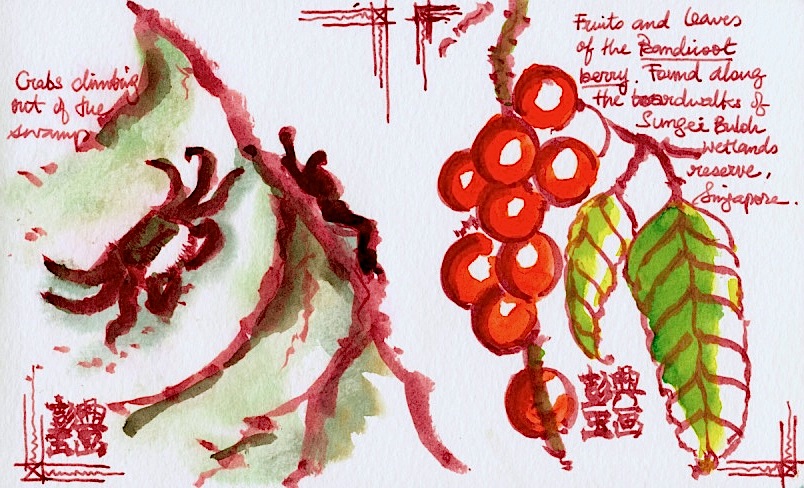 |
| Quick sketch and wash of tiny swamp crabs and Bandicoot berries done with my new Sailor Brush Pen at Sungei Buloh Wetland Reserve. |
On the right is a sketch of the Bandicoot Berry (Leea Indica). A decoction of the root is given in colic, is
cooling and relieves thirst. In Goa, the root is much used in diarrhoeal and
chronic dysentery. The roasted leaves are applied to the head in vertigo.
The juice of the young leaves is a digestive.
Sunday, 27 November 2011
Masjid Petempatan Melayu Sembawang (Malay Settlements Sembawang Mosque)
 |
| Set in a secondary forest, this mosque along Jalan Mempurong was completed in 1963 as a place of worship for the Malay Muslims staying in Sembawang. Before the mosque was built, Muslims living in kampungs nearby had to pray at suraus (Malay: small prayer house) or at the former Masjid Jumah Sembawang along Sembawang Road. In the early 1960s, funds were raised to build a mosque here. One of the biggest contributions came from Lee Foundation, which donated $10,000. When the mosque was completed, it was named Masjid Kampung Tengah, after the kampung it was located in. In 1960, the area along the coast was populated by the Malay community. This area was known as the Malay Settlement or ‘Petempatan Melayu Sembawang’. The mosque was later renamed after the settlement as Masjid Petempatan Malayu Sembawang. For many years, it served as the social and religious centre of neighbouring Malay kampungs. Important rituals were carried out here, such as the cukur rambut (Malay: shaving of newborns’ hair) and weddings. Extensive renovation works were carried out in 1984 and further upgrading was undertaken in 2007 for eight months before it re-opened in April 2008. Near the entrance, a tall rubber tree stands, the last one remaining from former rubber plantations here. Residents believed that there is a resident spirit in the tree as attempts to fell the tree have failed. |
Saturday, 26 November 2011
Books Cellar - Bookstore Cafe & Bistro
 |
| Bookstore Cafe by day and Bar by night - Have a cup of illy coffee with their home made sandwiches, read a book or surf/work with their secured WIFI. Throw some darts, shoot a game of Pool and chill out with a bottle of Heineken or a shot of whiskey. |
Saff Boutique Hotel, Keong Saik Road
 |
| The ornate Pintu Pagar of the Singapore shophouse is a unique feature of Peranakan style shophouses. The saloon style door provided privavcy to the dwellers while allowing air to flow freely for proper ventilation. |
Junction of Keong Saik Road and Teck Lim Road
 |
| Keong Saik Road was named in 1926 after the Malacca-born Chinese businessman, Tan Keong Saik, the son of Tan Choon Tian. The street in Chinatown is named in remembrance to his contribution to the Chinese community.[1] Keong Saik Road became a prominent red-light district with a high concentration of brothels located in the three-storey high shophouses flanking either side of the street in the 1960s. The street, along with Sago Lane areas became notoriously known as one of the "turfs" operated by the Sio Loh Kuan secret society.[2] The 1990s opened a new chapter for the road, with the site sprouting many "boutique hotels" like Royal Peacock Hotel, Hotel 1929, the Regal Inn and Keong Saik Hotel. Keong Saik Road now mainly houses coffee shops, art galleries and other shops for commercial use.[3] Keong Saik Road is located within a conservation area known as the Bukit Pasoh Conservation Area, which was given conservation status by the Urban Redevelopment Authority on 7 July 1989. The buildings in the area mainly consist of two and three storey shophouses in transitional, late and art deco architectural styles.[4] However, now the current Keong Saik Road is a far cry from the district it once was. Pubs, top rated restaurants, martial arts schools have popped in the vicinity and there are little traces of the brothels it was infamous for. The change in human and heritage landscape has been very significant. Teck Lim Road (Chinese: 德霖路) is named after Chinese businessman Ong Tek Lim, who is the son of Ong Kew Ho. He owned a shop known as Guan Tong (Ong Kew Ho & Company), which was well known for tapioca. Tek Lim was a Justice of Peace and was elected Municipal Commissioner which he held for three years and also gave a scholarship to the Anglo-Chinese School. The road is a one-way road linking Keong Saik Road to Neil Road in Chinatown within the Outram Planning Area of Singapore. The road is lined with conserved shophouses and houses a number of budget hotels. |
Friday, 25 November 2011


Wednesday, 23 November 2011
Central Fire Station, Singapore
 |
History
The idea for a professional Fire Brigade was conceived after a fire in Kling Street destroyed S$13,000 worth of property on 7 November 1855. It was 14 years before a volunteer fire service was started and a further 36 years before Singapore's first proper fire station — Central Fire Station — was built.
In 1905, planning for Central Fire Station began under the supervision of the Fire Brigade superintendent, Montague Pett. The station was completed in 1908. Built at a cost of S$64,000, it included a watch tower and living quarters for firemen.
Central Fire Station had four portable water pumps. Nonetheless, even this basic setting was a huge improvement over what existed before. Superintendent Pett fought for improved working conditions and initiated fire safety measures in public buildings. Standards of operations rose to a professional level and the degree of fire-related damage fell significantly.
The handing over of the fire service to Pett and the setting up of Central Fire Station was a welcome and much needed change. From that time, the Fire Brigade has consistently grown and improved. It became so invaluable that during the Japanese Occupation, the Japanese retained British firemen in their jobs, who were thus spared incarceration.
The Central Fire Station was gazetted as a national monument on 18 December 1998.
Tours
Although the Singapore Fire Service was integrated with the Singapore Civil Defence Force in 1989 and is no longer an independent entity, the Central Fire Station remains in use today.
The Civil Defence Heritage Gallery housed in Central Fire Station showcases the history of firefighting in Singapore, and reveals the developments of civil defence in Singapore from the 19th century till today.
Visitors to the heritage gallery can learn about the civil defence's progression in Singapore through the years, with displays of antique fire engines and other firefighting equipment. There are customised interactive stations for a close-up experience of what fire fighters and rescuers go through during a mission. There are also tours up the hose tower of the Central Fire Station, which was Singapore's highest point during the 1920s.
Cavenagh Bridge at Boat Quay, Singapore River
 |
Cavenagh Bridge, a Singapore River crossing, located in Central Region. Named after Sir Lieutenant General William Orfeur Cavenagh, the last Governor of the Straits Settlements (1859 - 1867) under British India control. It was built in 1868 and is today the oldest bridge across the Singapore River. It was the last major work of the Indian convicts based in Singapore. Now it serves as a foot-bridge for pedestrian traffic only. History In July 1856, there was a mere wooden foot-bridge where the Cavenagh Bridge now stands. In 1868, Cavenagh Bridge was built to commemorate the 50th Anniversary of the founding of the Crown Colony of the Straits Settlements held in 1869. It is named after Colonel Cavenagh, the last Governor of the Straits Settlements (1859 - 1867) under the Government of British India, although originally Governor Ord had planned for it to be named "Edinburgh Bridge" because it was first used during the visit of the Duke of Edinburgh to Singapore. Governor Ord eventually relented when members of the Singapore Legislative Council decided that it should honour and perpetuate the name of the last Governor appointed by the British East India Company to Singapore. Cavenagh Bridge was the last major project undertaken by Indian convict labour in 1869. Description Cavenagh Bridge was opened without ceremony. It was designed by Colonel G.C. Collyer, Chief Engineer of the Straits Settlements, with R.M. Ordish, of the Public Works Department, then under the charge of John Turnbull Thomson. Its steel structure was shipped out from Glasgow by P&W MacLellan, and constructed by these P&W MacLellan Engineers of Scotland of the Clutha Ironworks: the same company that had built the cast iron Telok Ayer Market. The Cavenagh family coat-of-arms can be seen on the cross-beams at both ends of the steel structure. The bridge linked Commercial Square (Raffles Place) and the government quarter, an essential alternative to get to the Post Office, replacing the ferry crossing which had cost a duit ("one cent") per ride. Although Cavenagh Bridge had trams trundling across it, all heavy traffic was diverted to the Anderson Bridge when it was built in 1909. Cavenagh Bridge was declared off limits to 'vehicles exceeding 3 cwts, cattle and horses', then was converted into a pedestrian bridge. Unfortunately, the bridge had not been designed to make allowances for the tides and as late as 1983, the bumboats (tongkangs in Malay or twa-koh in Chinese) plowing the river had to wait for low tide before making their way under the bridge. In 1987, Cavenagh Bridge underwent a five-month refurbishment by the Public Works Department (PWD), to preserve and strengthen its structure. The restoration work cost a total of $1.2 million and the bridge was reopened on 3 July 1987. Today it is the oldest bridge across Singapore River. Variant Names Chinese names: In Hokkien Hai-Ki thih tiau-kio, and in Cantonese Hoi-pin thit tiu-khiu, mean "Iron suspension bridge by the sea shore". |
Empress Place Building (Asian Civilisations Museum)
 |
The Empress Place Building (Chinese: 皇后坊大厦) is a historic building in Singapore, located on the north bank of the Singapore River in the Downtown Core, within the Central Area in Singapore's central business district. The building is currently the second wing of the Asian Civilisations Museum. The other wing of the museum is located at the Old Tao Nan School building along Armenian Street.
History
During the colonial era, the Empress Place Building was known simply as Government Offices. The first civic buildings were planned here in Sir Stamford Raffles' day. Originally intended to be a courthouse, the Empress Place Building instead became offices for the government departments located in the adjacent Maxwell's House (later the old Parliament House). Maxwell's House, designed by George Drumgoole Coleman, was a two-storey house built for a merchant, John Argyle Maxwell, in 1827. However, it was never occupied by him and it became a courthouse and lands office. Subsequently, it was converted to Government Offices and additions were made in 1839 and 1847. Constructed in four phases from 1864 to 1920, Government Offices was built to provide much needed space for the growing colonial administration. The original section of the building was designed by colonial engineer J.F.A. McNair and built by convict labour between June 1864 and December 1867. This original section now forms the part of the building nearest to the old Parliament House. Yet another courthouse was built in 1865; this is now the core of the Government Offices. In 1873-1875, the old courthouse was extended towards the river and this is where the Supreme Court of the Colony held its sessions from 1875 until 1939 when the first Supreme Court was built. Maxwell's original house became the Assembly House in 1954 after extensive renovations and reconstruction. The decision to build a new Town Hall was made in 1854; the building was completed in 1862. Government Offices that were housed included the Secretariat, Audit Office, Registration of Deeds Office, Land Office, Public Works and Medical Department, Treasury and Stamp Office, and the bureaus of the Colonial Engineer, the Official Assignee, and the Inspector General of the Police Force. The Legislative Chamber occupied a room on the upper floor. In front of the building was a public square which was given the name Empress Place by the Municipal Council in 1907 in honour of Queen Victoria. It may well be the oldest pedestrian space in Singapore. Over time, Government Offices became associated with Empress Place and its name changed to what we know it today. As the demand for more government office space increased, three major extensions were added in 1880, 1904-1909 and 1920. Fortunately, every one of these extensions were faithful to McNair's Neo-Palladian design and the building maintained a harmonious overall look. In the surrounding area also known as Empress Place, the Memorial Hall and Tower were added in 1905 and extensive renovations were carried out from 1954 till 1979. Raffles' statue, now in front of the Victoria Memorial Hall and Theatre, as it is now called, was first erected on the Padang in 1887 but later removed to its present site in 1919. A second statue, a copy of the first one, was erected at Raffles Landing Place in 1972. The Dalhousie Memorial was originally located at Dalhousie Pier but found its present place in 1886. Cavenagh Bridge was built in 1869 and was converted to pedestrian traffic after the erection of Anderson Bridge. These are the major elements which have contributed to the developing qualities of Empress Place. The Empress Place Building was used by government departments until the late 1980s. It is perhaps best known as the Registry of Births and Deaths, the Citizenship Registry, and the Immigration Department. In the late 1980s, plans were made to convert Empress Place Building into a museum. Extensive restoration began, culminating in the opening of the Empress Place Museum on 7 April 1989 by the then Second Deputy Prime Minister Ong Teng Cheong. Although the museum was afflicted with structural and logistical problems from its inception, it nonetheless managed to organise five outstanding exhibitions on Chinese history in six short years. The first of these exhibitions, which featured royal objects from the Qing Dynasty, put on display many precious artefacts never seen before outside China. By 1995, the museum's problems got the better of it and on 30 April that year, it closed its doors. Subsequently, the Empress Place Building underwent renovations and opened as the second wing of the Asian Civilisations Museum on 2 March 2003, exhibiting Southeast, South, and West Asian collections. The Empress Place Building was gazetted as a national monument on 14 February 1992. Architecture Located at the mouth of the Singapore River, the Empress Place Building's imposing Neo-Palladian exterior with timber-louvred windows and pitched clay tile roofs caught the attention of immigrants and visitors sailing into Singapore harbour. A 1905 Singapore guidebook describes Government Offices and its neighbouring buildings thus: "Apart from the cities of India, there is, perhaps, no place in the East which boasts such a handsome group of [government] buildings as viewed from the sea." Inside, the rooms are stately, with high ceilings, handsome Doric columns and exquisite plaster mouldings and cornices. Elegantly proportioned, the building is laid out symmetrically along a central axis. Asian Civilisations Museum (current use) The Asian Civilisations Museum (ACM, Chinese: 亚洲文明博物馆) is an institution which forms a part of the three museums of the National Museum of Singapore. It is one of the pioneering museums in the region to specialise in pan-Asian cultures and civilisations. The museum specialises in the material history of China, Southeast Asia, South Asia and West Asia, from which the diverse ethnic groups of Singapore trace their ancestry. History The museum first opened its doors at the Old Tao Nan School building on 22 April 1997 at Armenian Street, with exhibits largely centred on Chinese civilisation. With the restoration of the Empress Place Building, the museum established its new flagship museum there on 2 March 2003, rapidly expanding the collection to other areas of Asia. The Armenian Street branch closed for renovations on 1 January 2006 and reopened on 25 April 2008 as the Peranakan Museum, specialising in Peranakan culture. On September 16, 2006, the Museum officially launched its new logo with a new slogan The Asian Civilisations Museum - Where Asian Cultures Come Alive!. This new logo reflects the museum's unique location by the historic Singapore River, the source and origin of Singapore multi-cultural society, which the ACM presents in its collection. The brown reflected image also alludes to the museum as a place for reflection, while the vibrant orange is an invigorating colour which represents activity and energy. |
Tuesday, 22 November 2011
NOVEMBER SKETCHWALK 26 NOV 10AM.


Hi all, here is the sketchwalk plan for this saturday. We will be reprising Keong Saik for the new comers and covering Bukit Pasoh too, which will be a new area for us all. If you come late, please find us along this route.
Meeting/Endpoint - URA centre Atrium
Location #1 - Junction of Neil Road & Teck Lim Road
Location #2 - Keong Saik road
Location #3 - Bukit Pasoh (Majestic Hotel)
Date : 26th Nov 2011
Time: 10.00am --1.00pm (Sketchwalk)
1.00pm (Show & Tell @ Atrium)
Monday, 21 November 2011

Sunday, 20 November 2011

Restaurant sketch at Diandin Leluk.
 |
| A pit-stop at Diandin Leluk at Golden Mile Complex after the group sketchwalk. Did a quick sketch of fellow sketch mates Parka and Tony. |
The Golden Mile Complex
 |
| The Golden Mile Complex is a commercial and residential development, providing offices, shopping, entertainment services and apartment living within its podium and stepped terrace structure. It houses 411 shops, 226 offices and 68 residential units.[2] The building was designed by Gan Eng Oon, William Lim and Tay Kheng Soon of the Singapore architect firm Design Partnership, now known as DP Architects. Sited on 1.3 hectares and built to a height of 89 metres (292 feet),[5] the Golden Mile Complex is an exemplary type of "megastructure" described by architectural historian, Reyner Banham. It is one of the few that have been actually realised in the world. Pritzker Architecture Prize laureate Fumihiko Maki had called the Golden Mile Complex a "collective form". It successfully propagates high-density usage and diversity under a broad range of ideas advanced by the Japanese Metabolist Movement of the 1960s. The complex was designed as a "vertical city", which stands in contrast to homogenised cities where functional zoning restrains all signs of the latter's vitality. Conceived as a prototype for a lively environment, the design of the Golden Mile Complex was intended to catalyse urban development along Beach Road by employing an extruded section that would stretch along the East Coast facing the sea. In terms of public transport and accessibility, the building is serviced from the rear on Beach Road, instead of its frontage with Nicoll Highway, with a continuous pedestrian spine linking all buildings in the Golden Mile of Beach Road. The design was influenced by the linear city concepts of Le Corbusier and Arturo Soria y Mata.[6] The stepped profile of the Golden Mile Complex offers the occupants of the apartments on the upper floors a panoramic view of the sea and sky. All the apartments have balconies, and two-storey maisonette penthouses crown off the building. The narrowness of this sloping slab form enhances natural ventilation and shades a lofty communal concourse above the podium along Beach Road. The stepped design also reduces the impact of noise from the road traffic. The Golden Mile Complex preceded by several years avant-garde stepped-section buildings which were built in the United Kingdom and Europe.[6] The lower floors contain offices and a retail mall, located within staggered atria to allow natural light into the heart of the building. |
The Church of Our Lady of Lourdes
 |
| The Church of Our Lady of Lourdes was constructed in 1888. This is the first Tamil Catholic church in Singapore. Its design is modelled after the original church at Lourdes, France.
Many architectural historians attribute this building to Swan & Maclaren, but it was more probably designed by a priest–architect, such as Father Nain, as many other Catholic buildings in Singapore were at the time. It could not have been executed by Swan & Maclaren, to whom it is often attributed, as the partnership was not formed until 1893, at which time the building was completed. More than likely the plans were submitted by A.W. Lermit of Swan & Lermit. Today, the Church is used, up to a point, for the purpose for which it was built, i.e. as a worshipping place for Tamil Catholics. However, over the last decade, and in the interests of a multi-racial nation, it has welcomed Catholics of all races. Masses are held in English, Tamil and Singhalese. The Church of Our Lady of Lourdes was gazetted as a national monument on 14 January 2005. |
Subscribe to:
Posts (Atom)