Tuesday, 11 December 2012

The Corner House that became The Garden

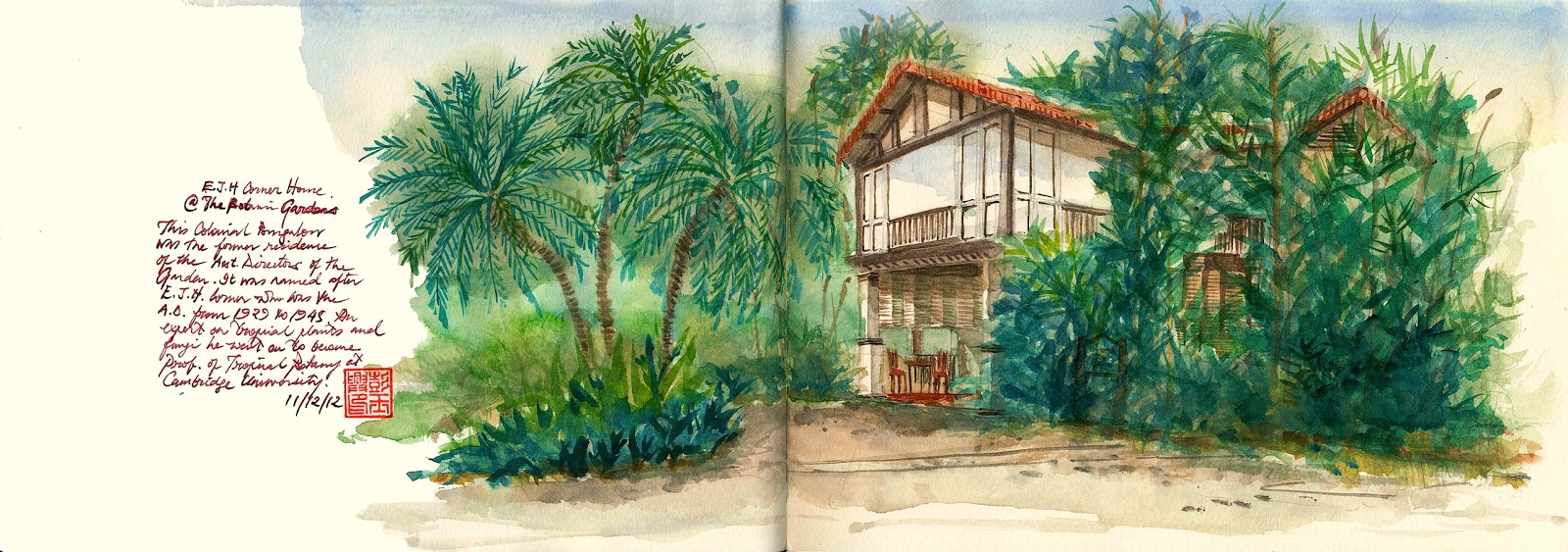
E.J.H. Corner House at Singapore Botanic Gardens
This is a colonial bungalow that was formerly the residence of the Assistant Directors of Singapore Botanic Gardens. It is named after E.J.H. Corner who was Assistant Director in the period 1929-1945. Corner was an expert on fungi and tropical trees and palms. He went on to become Professor of Tropical Botany at the University of Cambridge.

Edred John Henry Corner FRS (12 January 1906 – 14 September 1996) was a botanist who occupied the posts of assistant director at the Singapore Botanic Gardens (1926–1946) and Professor of Tropical Botany at the University of Cambridge (1965–1973). Corner was a Fellow of Sidney Sussex College from 1959.

His studies of seed morphology led him to formulate the Durian Theory of the origin of flowering plants. He was also a leading expert on the genus Ficus and the palm family, as well as a distinguished mycologist, having published Boletus in Malaysia in 1972.

Among his many academic prizes were the Darwin Medal (1960), the Linnaean Gold Medal (1970), and the Japanese International Prize for Biology (1985).

He was a controversial figure, viewed by some as a collaborator with the Japanese during the World War II occupation of Singapore. In fact he was only offered the chance to continue his work in the Singapore Botanic Garden at the instigation of the ousted British governor, Sir Shenton Thomas, and he was treated by the Japanese as an enemy alien, being required to wear a distinguishing red star on his clothing. His account of this time is contained in The Marquis - A Tale Of The Syonan-to (1981). He also wrote a Biographical Memoir of the Emperor Hirohito for the Royal Society.
Corner has also gained some notoriety among creationist circles in recent years for a frequently circulated quotation: "...but I still think that to the unprejudiced, the fossil record of plants is in favor of special creation." Here is the full quote:
The theory of evolution is not merely the theory of the origin of species, but the only explanation of the fact that organisms can be classified into this hierarchy of natural affinity. Much evidence can be adduced in favour of the theory of evolution - from biology, bio-geography and palaeontology, but I still think that, to the unprejudiced, the fossil record of plants is in favour of special creation. If, however, another explanation could be found for this hierarchy of classification, it would be the knell of the theory of evolution. Can you imagine how an orchid, a duckweed, and a palm have come from the same ancestry, and have we any evidence for this assumption? The evolutionist must be prepared with an answer, but I think that most would break down before an inquisition. Textbooks hoodwink. A series of more and more complicated plants is introduced - the alga, the fungus, the bryophyte, and so on, and examples are added eclectically in support of one or another theory - and that is held to be a presentation of evolution. If the world of plants consisted only of these few textbook types of standard botany, the idea of evolution might never have dawned, and the backgrounds of these textbooks are the temperate countries which, at best, are poor places to study world vegetation. The point, of course, is that there are thousands and thousands of living plants, predominantly tropical, which have never entered general botany, yet they are the bricks with which the taxonomist has built his temple of evolution, and where else have we to worship?" (E.J.H. Corner 1961, from 'Evolution', p. 97, in "Contemporary Botanical Thought", Anna M. Macleod and L. S. Cobley (editors), Oliver and Boyd, for the Botanical Society of Edinburgh)
Among the many plant species named in his honour are Anisophyllea corneri, Calamus corneri, Bulbophyllum corneri, and Platyscapa corneri.


Sunday, 9 December 2012

The (re)New(ed) Starbucks at Raffles City

The renewed Starbucks at Raffles City
The new Starbucks layout at Raffles City. The new layout is more open and spacious. There is no inside/outside anymore. Sitting here as the sun streams in reminds me of summer in Paris.

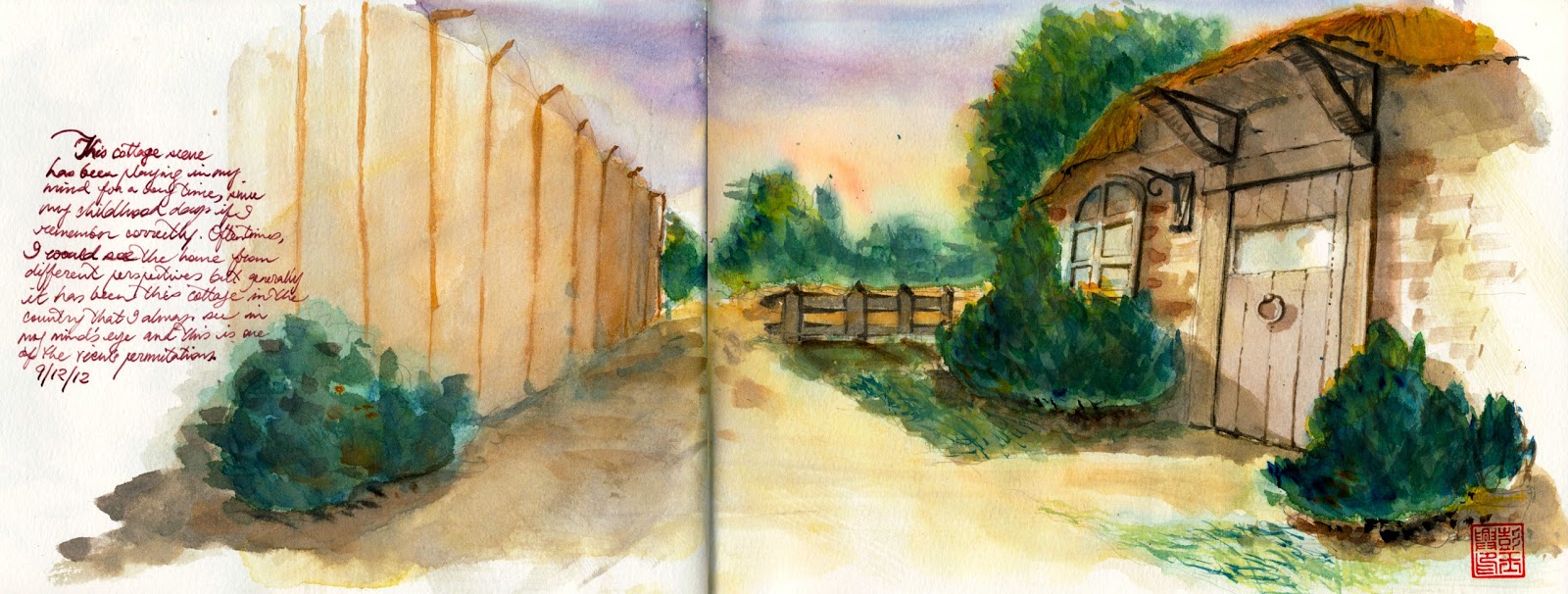
Cottage of my Childhood

I've always seen this in my mind's eye as a child...
This cottage scene has been playing in my mind for a long time, since my childhood days, if I remember correctly. Oftentimes, I would see the home from different perspectives, but generally, it has always been this cottage in the country that I always see in my mind’s eye. This one of the views’ permutations.


Wednesday, 5 December 2012

Cafe Sketchwalk 1.3 - Chye Seng Huat Hardware Coffee Bar

Up close and personal with the espresso machines and baristas.
I first learned about Chye Seng Huat Hardware (再成發五金) Coffee Bar when my friend posted their visit on Facebook. I was intrigued and tickled by the very old school, traditional Chinese family business name.

However, the place is anything BUT old school. The hustling and bustling interior serves fantastic Java with beans prepared at its very own roastery just next to its dining area.

There is a comfort in watching the baristas methodically prepare the orders of coffee during peak hours. Even during peak periods, they will still patiently prepare yours with intricately designed latte art: individually, carefully, beautifully.

This is definitely a place that demands a second visit - to explore the menu, experience the space and indulge in the atmosphere.

Cafe Sketchwalk 1.2 - The Broers Cafe

The sparse and cavernous interior of The Broers Cafe
What defines coffee? Is it a habitual cuppa to get your morning grooves, or a cup of sunshine on a cold, rainy day? At Broers, coffee is an ever changing experience depending on what you drink, how you drink it, and when you drink it.

But coffee is only one aspect when you step into the Broers Cafe. Amazing things happen here on a daily basis because we work magic with our brew. There are no rocket sciences involved. Simply start with a great cup of coffee, continue with a conversation and suddenly, you are connected by a common experience. Don’t be too surprised when you find yourself sharing this one-of-a-kind intimacy with someone else across the room. At the Broers Café, our brew is 10% caffeine and 90% soul. This explains the warm fuzziness you feel spreading in your belly and the inexorable Cheshire grin that follows afterwards.

Come down to the Broers Café today and discover more about what goes into our cup of brown nirvana. Leave your inhabitations at the door, order your java, kick back in your seat and prepare to embark on an epicurean adventure!

Broers. We make great coffee and even better company.
The above is the text from The Broers Cafe website.

However, the obverse could not be more true. My friend and I went in and experience the cold atmosphere in the cafe - both physically and emotionally. All except for one lady of the service staff greeted us. When we asked to find out more about the cafe, the owner, could not even be bothered to look at us, directed us to the website instead. And this message was conveyed to us via the service staff, who was the only warm face during our visit.

When I finally got the chance to visit the website, I couldn't help but laugh at the ridiculous irony that was written on it. It could well have been gibberish and gobbledy-gook, because it describe a completely different place that my friend and I encountered.

With so-so coffee and even worse service, I would neither recommend nor visit again.


Cafe Sketchwalk 1.1 - L'Etoile Cafe


Started the day meeting up with friends at L'Etoile Cafe at Owen Road. I was there for brunch and had their delicious french toast with scrambled eggs and bacon. It was a delicious fare - not too greasy nor was the maple syrup accompanying the toast too sweet. There was even a nice hint of cinnamon in the syrup. I had their flat white to wash the brunch down... it was so good, I had two - coffees that is.

However, what must be the main draw of the place is the environment. Set like a French-influenced Japanese cafe, the place has a charm and quaintness that blends itself beautifully into the quiet and comfortably appointed interiors.

This is a definite place to visit for some chill time alone or with friends.


Monday, 3 December 2012

Wet Day in the Orchard.

Rainy day in Orchard Road...
On the way home - father and son walking in the rain.
It was a day when I was suppose to be draughting my short stories. The rain made it hard to focus when the dampness and howling wind turn the temperature uncomfortable. My attention then turn towards the people on the sidewalk making their way around town.

I was particularly taken by a father and son duo. The son was lively and animated, pointing things out to his dad. And for that moment while I witness the scene, the cold seem to melt away...

Saturday, 1 December 2012

Orchard in the Monsoon.

Orchard Road Promenade outside Liat Towers after the rain.
Orchard Road got its name from the nutmeg, pepper and fruit orchards or the plantations that the road led to in the mid-1800s. Commercial development only began in the twentieth century, and took off in the 1970s.

Orchard Road was already cut in the 1830s, though the new road was not named in George Coleman's 1836 Map of Singapore. In the 1830s the Orchard Road area was the scene of gambier and pepper plantations. Later, nutmeg plantations and fruit orchards predominated, hence its name.

By 1846, the spread of houses had reached up to Tank Road. There were none on the left side and only three or four houses went past Tank Road on the right side of Orchard Road.

One major sight during this period was a Dr Jun tending his garden, which helped endorse the road's name. He had a garden and plantation at the corner of what is now Scotts Road and Orchard Road.

Towards the later part of the 1840s, graveyards began to appear along the road. By 1846, the Chinese had a large graveyard around what is now the Meritus Mandarin Hotel and Ngee Ann City, while the Sumatrans from Bencoolen had their burial ground where the current Grand Central Hotel stands. Later a Jewish cemetery was established; it was located where Dhoby Ghaut MRT Station is now situated, and demolished in 1984.

In the 1860s, Orchard Road had a great number of private houses and bungalows on hills looking down through the valley where the road passed through. Early in the 1890s, King Chulalongkorn, the then King of Siam, acquired "Hurricane House" in the vicinity of Orchard Road through Tan Kim Ching, the Thai Consul in Singapore. Two further pieces of adjoining property were added later and these subsequently became the site of the present Royal Thai Embassy at 370 Orchard Road.

In the early 20th century, it was noted that Orchard Road "present[ed] the appearance of a well-shaded avenue to English mansion[s]", comparable in its "quiet but effective beauty to Devonshire lanes." The Chinese called the area tang leng pa sat koi or "Tanglin market street". The Tamils refer to the road as vaira kimadam or "fakir's place", and muttu than (high ground), a reference to the hilly nature of the area.

Flash floods occurred at the road's iconic junction with Scotts Road on 16 June 2010 after 100mm of rain fell from 8 am to 11 am that morning, reportedly the worst flood at the junction since 1984. Shopping malls along Orchard Road like Lucky Plaza and Liat Towers were affected by the flood. The flood had caused some shopping mall and car park basements to be submerged in the water. Rescuers had to pull out about 70 passengers from cars and buses, as flooding shut down Orchard Road, which is lined with high-end shopping malls and tourist attractions. No one was injured.


Thursday, 29 November 2012

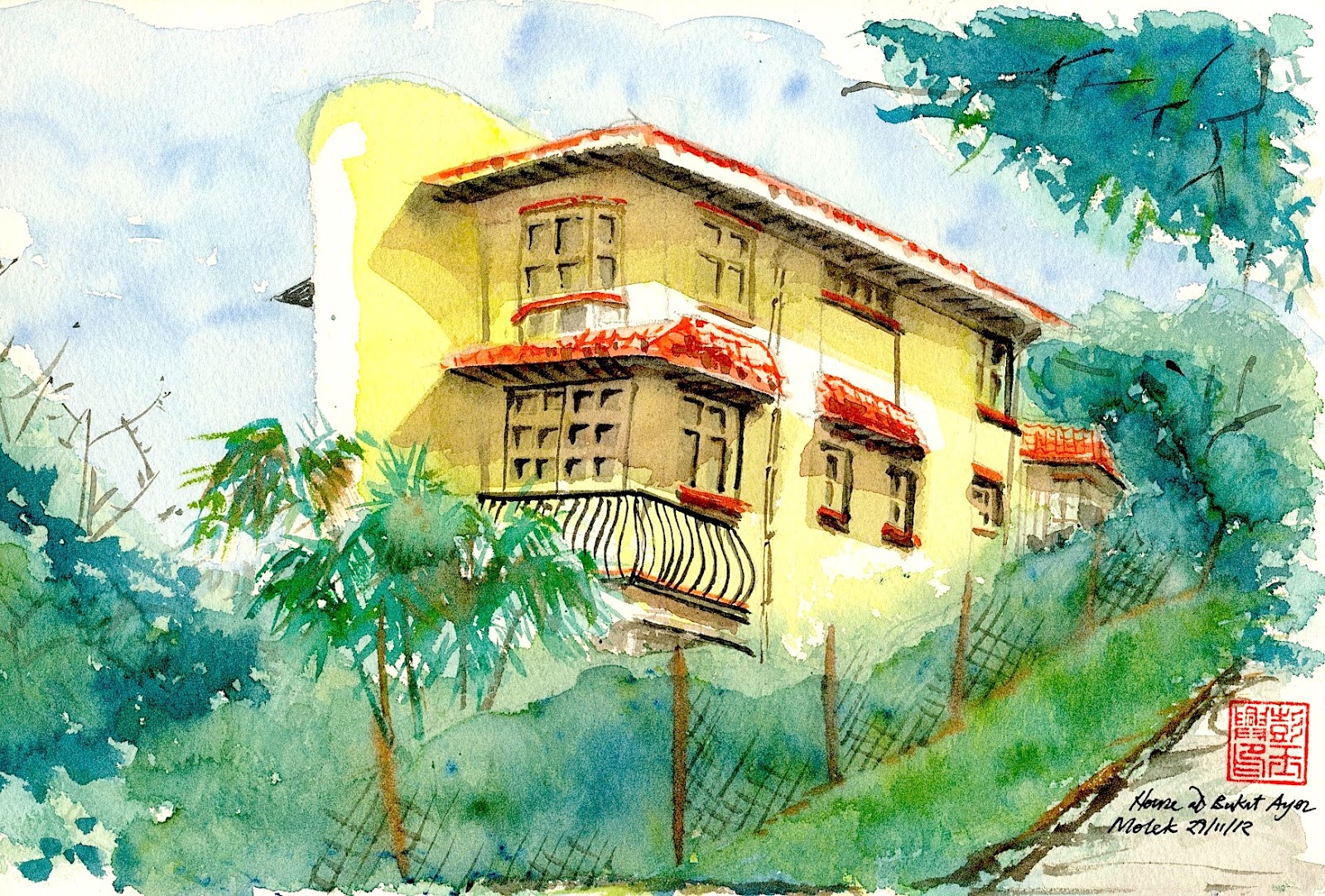
The 'Prairie House' along Bukit Ayer Molek

‎House 1A at Bukit Ayer Molek.
Came across this house on the expressway on my way back from school the other day and went back to make paint it. I love its 'prairie house' proportion and how it is built on a slope, following the land's natural contours. I didn't see any bodies of water so I don't know where the air molek (beautiful water) is.

Sunday, 25 November 2012

People watching at Starbucks (as usual)

People watching at Starbucks, Liat Towers.
It was a rainy day today and the cafe was empty when I arrived...

... and then it filled up as the evening approached and the rain fizzled off.

Saturday, 24 November 2012

Commonwealth Estate

The iconic block 38 at Commonwealth Avenue.

Commonwealth Estate is an estate in the Queenstown Planning Area (which includes the Queenstown Housing Estate). It is bounded by the Ulu Pandan Canal, Ghim Moh Housing Estate and the former Tanglin Camp area to the north, Alexandra Road to the east, Clementi Road to the west and the sea to the south. It covers an area of approximately 2,188 ha.

The total population (1990 census) is 126,071 with 31,131 housing units.[4] It consists of 16 subzones, namely: Ghim Moh, Holland Drive, Commonwealth, Tanglin Halt, Margaret Drive, Mei Chin, Queensway, Portsdown, Buona Vista, Singapore Polytechnic, Dover, National University, Kent Ridge, Pasir Panjang, Pasir Panjang II, and the Port.

The main housing areas within Queenstown include:
  • Princess Estate is the first sub district of the Queenstown District consists of several precincts like Strathmore, Dawson
  • Duchess Estate is the second subdistrict of Queenstown district which consists of Queenstown Centre and Margaret Drive. Several blocks of 2-storey and 3-storey flats are located in this area.
  • Tanglin Halt consists of rows of ten storey flats, fondly remembered as Cap Lau Cu(十楼厝). Many of the flats in this area are currently undergoing upgrading. Several 40 storey flats are built.
  • Commonwealth Estate is located near the Commonwealth MRT station and consists of precincts like Commonwealth Close and Commonwealth Crescent. It is best known for having a fantastic view of Singapore's Downtown.
  • Queen's Close is a cluster of flats bounded by Mei Ling district, Portsdown Road and Alexandra Road. Queen's Crescent is now demolished.
  • Mei Ling/Mei Chin is built from the excavation of two hills, Hong Lim and Hong Yin Hill which are used for cemetery purposes. It is also where Queenstown district got its name Boh Beh Kang, or a river with no source.
  • Buona Vista is the last district built in Queenstown. However, it has developed a distinct and unique identity today that is commonly not linked with Queenstown.


Friday, 23 November 2012

This dinner rmarks the end. Woo hoo!

End-of-Year staff dinner at Tiffany's


Last day of work! Hello holidays!

Can you tell that we're all excited?
It's finally the last day of work!

Marina Bay

Gardens by the Bay - one of the attractions at Marina Bay.

-->
Marina Bay is a bay near Central Area in the southern part of Singapore, and lies to the east of the Downtown Core. Marina Bay is set to be a 24/7 destination with endless opportunities for people to “explore new living and lifestyle options, exchange new ideas and information for business, and be entertained by rich leisure and cultural experiences”.[1] It is here where the most innovative facilities and infrastructure such as the underground “common services tunnel” are built and where mega activities take place. 

In 1970s, land reclamation was carried out at Marina Bay, forming what is today the Marina Centre and Marina South areas. In the reclamation process, Telok Ayer Basin was removed from the map, while the Singapore River's mouth now flows into the bay instead of directly into the sea. In 2008, Marina Barrage was built, asin into a new downtown freshwater Marina Reservoir, providing water supply, flood control and a new lifestyle attraction.


Thursday, 22 November 2012

Make-A-Difference Day.

An onslaught of presentations and sharing.
Yes, you read it right: it's MAD day in the office.

Wednesday, 21 November 2012

Urban Sketchers SIngapore: November Official Sketchwalk


This saturday's sketchwalk will be around Stirling Road. We will meet at Blk 49 Stirling Rd at a small Nasi Padang coffeeshop in the morning at 9.30. The food there is not too bad. But their breakfast mee goreng is so-so only. So order other things if you want to eat there. This is the picture of where we will meet.


From there, we will spread out in any direction we like, free and easy. There is a lot of variations here. That's why we picked this place. Old HDB flats and two-storey terraces lay side by side around this area. Lots of high and low structures. There is the Queenstown swimming complex and Mei Ling hawker centre just a little further up the road. If you like to revisit the demolished and revamped Queenstown area just cross Commonwealth Ave and you will see a giant field where Blk 38 is still standing. Oh! The Queenstown library is still standing along Margaret Drive. Probably the oldest library in Singapore now. It's a simple but interesting area to draw. Talk, walk, relax and sketch. We will meet again at 1230pm on the left side of block 49 Stirling Rd (shown above). There is an open area next to the block suitable for show and tell.

CAUTION: Stirling Rd is small but it is a TWO way road. So please look both ways when you cross!

Here is the link for the map on google maps. Click HERE.
The closest MRT is Queenstown MRT. Or else, just find a bus that goes along Commonwealth Ave.

Call Urban Sketcher Andrew at 91070735 if you can't find your way.

See you there!


Saturday, 17 November 2012

Thursday, 15 November 2012

A River Runs Through It...

Whampoa River along McNair Estate
The Whampoa River that flows through my estate. This used to be a natural river that was widened into a canal and then improved to its current Active Beautiful Clean state.

Tuesday, 13 November 2012

Herb Garden at Masjid Penempatan Melayu Sembawang

The herb garden at Masjid Penempatan Melayu Sembawang
While I was exploring the grounds of the mosque at Sembawang, I found this herb garden within the compound. The place was filled with medicinal and culinary plants. It was such a joy to look at the variety of plants - pandan, buah ceri, aloe vera, etc. I couldn't resist but did a quick outline sketch of the place. I finally found time to fill it with colour today.

Bottle Tree Village and Jalan Mempurong

The tranquil scenery of Jalan Mempurong.

Sembawang Park

Sembawang Park, a 15 hectare tranquil park developed in the 1970s and maintained by the National Parks Board, is situated at the Northern tip of Sembawang Road. One of the few parks in Singapore with a natural beach, the Wak Hassan Beach, this park is a heaven for city dwellers who are tired of the never-ending concrete buildings and sky-scrapers. It's a popular spot for campers as well as families who wish to spend an idyllic day by the beach. One can dine at the Beaulieu House, built in 1910, which was the residence of Admiral Sir Geoffrey Layton (Commander-in-Chief British Eastern Fleet, 1940–1942). A wide range of fauna and flora awaits visitors, ranging from the spectacular Cannon Ball tree (Couroupita guianensis) to the many species of birds which have made the park their nesting grounds

While fellow-sketchers focussed on the local landmark of Masjid Penempatan Melayu Sembawang, I decided to turn my attention to the tranquil scenery of the road that leads to the mosque and subsequently the beach overlooking Johor Bahru, the road that is named Jalan Mempurong.

Bottle Tree Village and Jalan Mempurong

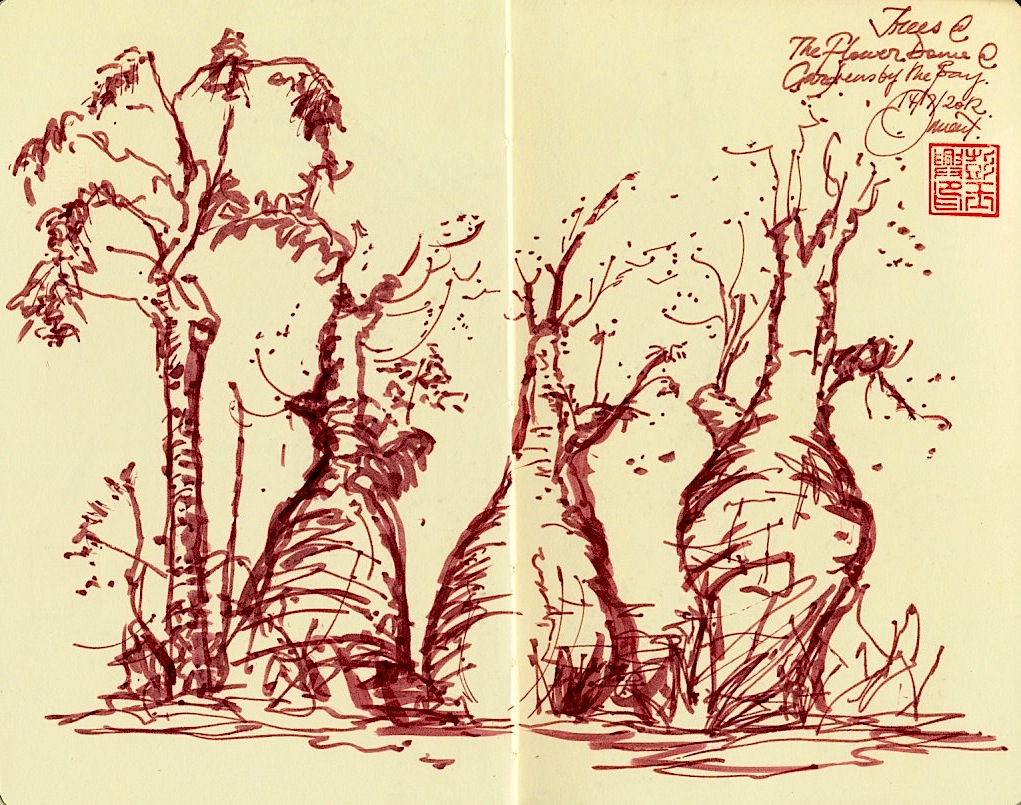
The Bottle Tree Village is located at the end of Jalan Mempurong and is known for its Bottle Trees (Brachychiton rupestris) flown in from Queensland, Australia. Apart from these, other Australian flora can be spotted in the surroundings.


Saturday, 10 November 2012

Like a beacon pointing to the Heavens

Roof details of the Sultan Mosque - like candles lit and pointing towards heaven.
These details echo the minaret of the mosque. The earliest mosques were built without minarets, the call to prayer was performed elsewhere; hadiths relay that the Muslim community of Medina gave the call to prayer from the roof of the house of Muhammad, which doubled as a place for prayer. Around 80 years after Muhammad's death the first known minarets appeared.

Minarets have been described as the "gate from heaven and earth", and as the Arabic language letter alif (which is a straight vertical line).


Return to Kampung Glam: Malay Heritage Centre

This main building at the Malay Heritage Centre used to tbe official residence of the Sultan of Singapore.

Detail: Potted plant at the main entrance.
Officially opened by Prime Minister Lee Hsien Loong in June 2005, the Malay Heritage Centre (MHC) provides wonderful cultural exposure and learning opportunities for visitors of all ages and interests. Situated amidst the Istana Kampong Gelam, Gedung Kuning and the surrounding Kampong Gelam precinct, the Centre acts as a vital heritage institution for the Malay community in Singapore. Through its exhibits, programmes and activities, the Centre hopes to honour the past while providing a means for present-day expression. The Malay Heritage Centre is presently under the management of the National Heritage Board in partnership with the Malay Heritage Foundation.


Thursday, 8 November 2012

Kampong Glam Sketchwalk with Kiah Kiean on Saturday, 10th November 2012

Sketch of Sultan Mosque from 2 years back.

Dear fellow sketchers,

USK-Sg is very privileged to have Kian Kiean from Penang for this special sketchwalk to Kampong Glam this coming Saturday (10th Nov). They are very eager to sketch along side us.

We will meet and start 9.30am at Kampong Glam's Sultan Mosque main entrance (facing Baghdad road). At 12.30pm we will gather again near the mosque for a show-and-tell session.


Saturday, 3 November 2012

Christmas is here...

Tea and macaroons at Canele
Passed by Marks and Spencers and saw their Christmas merchandise on display. I came across their specially-packaged tin boxes of Amaretti and was rather tempted to buy them until I saw the ridiculous price tag of SGD29.90 for a 200-gram tin. While having tea and macaroons at the nearby Canele, I searched for the recipe and was tempted to try it out.

The result is this:
My first attempt at making Amaretti. Not too shabby, eh?


Red Anjous in Season!

I absolutely adore Red Anjou pears with their deliciously soft and sweet flesh and October marks the beginning of their season all the way to Spring! I got some from the neighbourhood supermarket yesterday and thought they were too good to be just eaten and decided to sketch them for posterity...


Red Anjou pears are much like their green counterparts in all respects other than color. Their shape, flavor and texture are similar, and it's their deep, rich, maroon color that sets this variety apart, particularly as a showy pear among pears in a fruit bowl or basket.

Identifying Red Anjou Pears

With a silhouette identical to Green Anjous, Red Anjous are just as easy to identify by their shape. Although there are other red varieties of pears available, such as Red Bartlett, Red Anjous are recognizable for their egg-shaped appearance; having a large spherical lower potion that begins a gradual and even taper above the mid-point to a smaller, rounded top. The color of Red Anjous varies from pear to pear, however they are generally dark maroon in color, sometimes with light vertical streaks of color that were naturally created by the sun while the pear was still on the tree.
back to top

Seasonality of Red Anjou Pears

The popularity of Red Anjous has brought a great deal of attention for this variety. Planting of Red Anjou pear trees in the Pacific Northwest has been on the increase, and they can now be found in markets from late September or early October through the spring months.
back to top

Ripening

Red Anjous show only slight change in color as they ripen, which is another characteristic shared with their Green Anjou counterparts. The best indication of ripeness for any pear is the thumb test: gentle thumb pressure near the stem will yield slightly when the pear is ripe.
Red Anjous, like all pears, ripen when held at room temperature. Depending on their level of ripeness when purchased, it may take several days before they are ready to eat. The results, however, are well worth the wait. Red Anjous develop a mild, sweet flavor with very smooth texture and abundant juices when ripe.
back to top

Beautiful Red Displays

Although they share most characteristics with Green Anjous, Red Anjous do possess one very distinctive appeal - their color. Displayed in a fruit bowl or basket on a counter or as a table centerpiece, their color sets a brilliant tone. Consider a full display of Red Anjous for Valentines Day. During the winter holidays, combine Red and Green Anjous to create a display with the appropriate colors of the season.
back to top

Culinary Uses

Because their red color is only skin deep, you'll notice no difference in cooking with Red Anjous than using Green Anjous if the recipe calls for peeling the pears. However, in a recipe calling for fresh pears (if leaving the skin on) the red color can add striking contrast and eye appeal. Consider a garden green salad tossed with slices of Red Anjou pears!
back to top

History of Red Anjous

Red Anjous originated as naturally occurring bud sports found on Green Anjou trees. "Bud sports" are spontaneous, naturally occurring transformations that crop up on trees, and they are most often unnoticed. Red Anjous, however, are an exception. Actually, they are an exception that occurred twice, as the first red sport of Anjou was discovered in the early 1950's near Medford, Oregon, and a second red sport was discovered in the late 1970's in Parkdale, Oregon.
back to top

Thursday, 1 November 2012

New Starbucks: Reopening at Plaza Singapura

The newly reopened Starbucks at Plaza Singapura.
Starbucks has reopened at Plaza Singapura with a bigger floor space and a more defined layout for various activities. The newly extended shopping mall itself which has taken up the neighbouring Atrium@Orchard now has its visitors spoilt for choice when it comes to cafe hangout with familiar brands like Canele and Dome as well as a couple of new Japanese entrants. It also boast a more upmarket line-up of tenants like Kiehl's, Gap, etc.

Tuesday, 30 October 2012

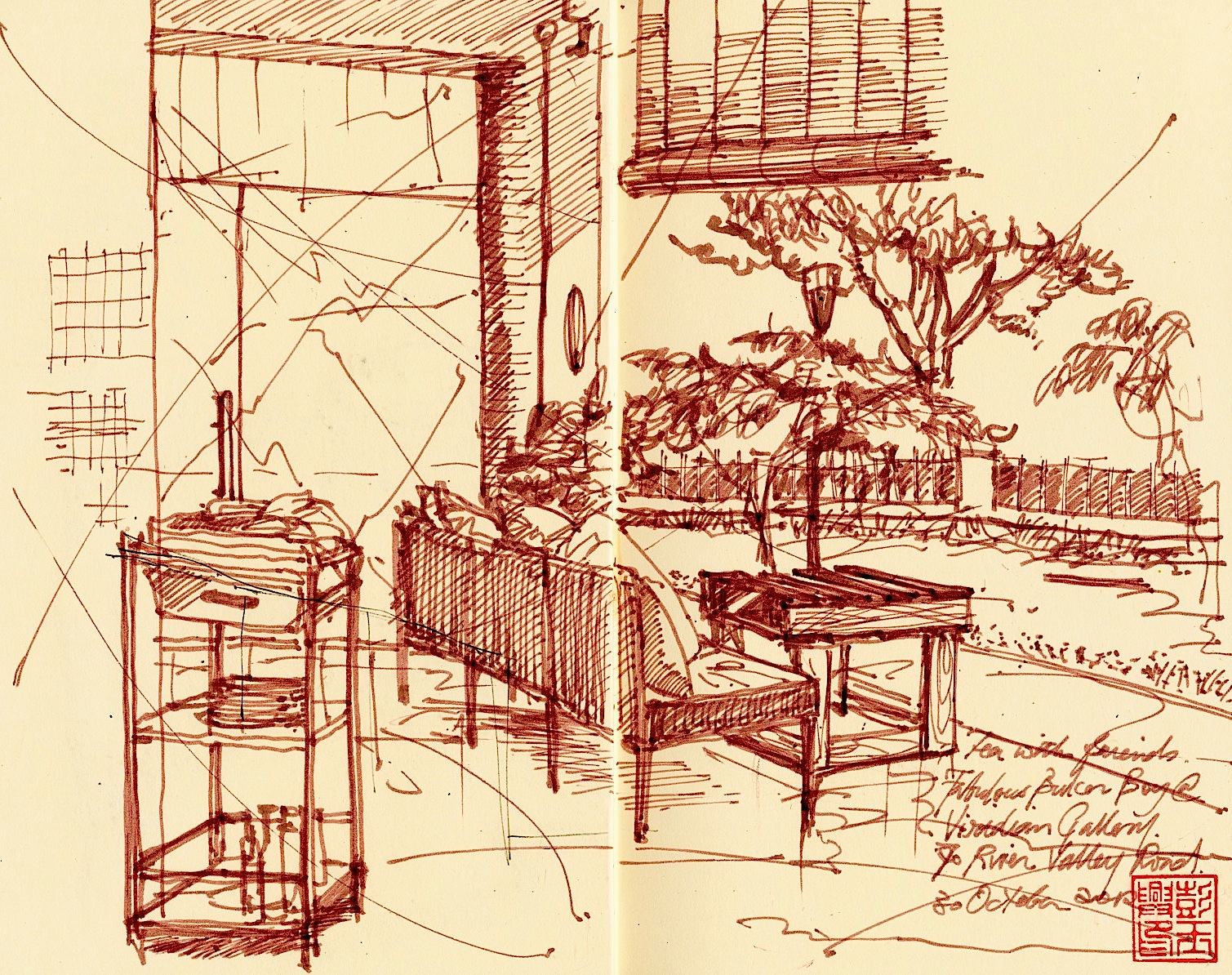
Cakes and Bakes with the Fabulous Baker Boy!

Peaceful. Quiet. Serene.
Every baked treat that is created in the fab kitchen comes from a place of passion, pride and the utmost quality. Every bite you take will take you back to that place of love and comfort.
Come … Eat some cake!

Juwanda's (the baker) recipes have been created and developed over a long period time. Most of them come from the parties that he had planned and cooked for, the chefs in the various kitchens of his career, the invaluable skill and taste that his parents have cultivated in him and of course his kitchen Gods and Goddesses.

The Fabulous Baker Boy loves cooking, baking and feeding people and wants to change the world one heart and tummy at a time.

Go on! Have some cake and eat them too!


Sunday, 28 October 2012

Grimming and Chilling

Multitasking.
Catching up on Grimm while coffee-ing and snacking and chillin' out at Starbucks.

Saturday, 27 October 2012

On The Way Home

The (new) way home...
ON THE WAY HOME... it's the same road that leads you to the place of refuge; that sanctuary, that shelter that shields you from all the craziness of the world. It's THAT place that lets you know... no matter how far you go, no matter how crazy the world out there becomes, there's this ONE place that will always remain the same for you.

Another Day at the Gardens by the Bay

The orchids that weren't there when I first visited in the middle of this year are now lush, beautiful and welcoming

This is the garden that I can visit a whole day without tiring. This is the view. This is the reason.


Monday, 23 July 2012

Hot Hot Day in Little India, Singapore

It was a hot hot day today. I wanted to cool off with a kopi-c peng (iced coffee with evaporated milk) when I spotted this old spot along Dunlop Street with its beautiful contrast of dark and light. I hope I did it justice...
Dunlop Street is in Little India, a one-way road connecting Jalan Besar to Serangoon Road. Named after Colonel Samuel Dunlop, the most significant landmark along this street is the Abdul Gaffoor Mosque.

History
The street was probably named after Colonel Samuel Dunlop who served in Singapore as the Inspector-General of Police of the Straits Settlements in 1875 and as a member of the Municipal Commission in 1887. It is also probable that this street was named after A.E. Dunlop, Secretary of the Race Course Committee of the Serangoon area. Before the 1870s, this street was known as Rangasamy Road. This street is a part of the Urban Redevelopment Authority's conservation area of Little India.

Key features

The street is mostly lined with modest two-storey shophouses, selling anything from textiles to terracotta pots. They are good examples of terrace shophouse architecture. A few decorative houses are also present. The last charcoal shop in Little India was located on this street. The eateries on the bylanes of this street serving a wide variety, continue to be frequented by tourists and locals.  Abdul Gaffoor Mosque, one of Singapore's oldest mosques, was originally built in 1881. The old mosque was demolished and a new mosque with architecture in Saracenic and Roman themes was erected at the same site in 1910.

Renovated in 2001, the mosque used to serve the religious needs of South Indian Muslims, mostly the Tamils.  Abdul Gaffoor, a trustee of the mosque in the late 1880s, was instrumental in constructing shophouses along Dunlop Street to financially assist in the mosque's maintenance. It was gazetted as a national monument in 1979.

Another endearing landmark that used to be on the street was the P. Govindasamy Pillai (PGP) building.  Pillai was a wealthy Indian businessman who also donated generously for the good of his fellow Indian community in Singapore.  By late 1998, the PGP store had closed, much to the sadness of many Indians in Singapore who remembered the man, his store and kind deeds fondly.  Other buildings situated on this street are the Madras Hotel and Jothi's Building.

Thursday, 19 July 2012

Reflecting... (at MacRitchie Reservoir in the evening after an afternoon shower)

End of a long day. Trying to collect my thoughts and planning a few next steps...

There is something very comfortable about staring at a seemingly endless body of water. It's very mesmerising. Very therapeutic.

Saturday, 14 July 2012

Gardens by the Bay, Singapore.

In the Flower Dome
Bottle Trees
Left: Olive Tree, Right: Canary Islands Dates
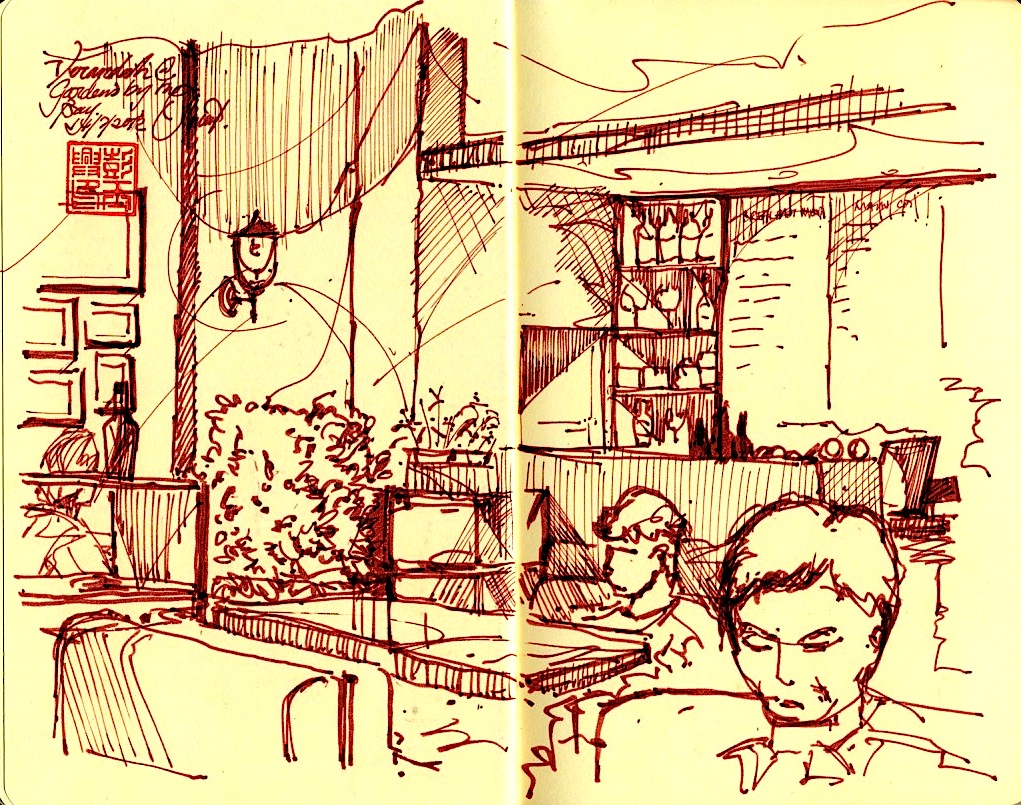
Verandah Bistro at Gardens by the Bay
Gardens by the Bay (Chinese: 滨海湾花园) consists of three distinct waterfront gardens – Bay South, Bay East and Bay Central, set in the heart of Singapore’s new downtown Marina Bay, adjacent to the Marina Reservoir.

Spanning 101 hectares, Gardens by the Bay is an integral part of a strategy by the Singapore government to transform Singapore from a ‘Garden City’ to a ‘City in a Garden’. The stated aim is to raise the quality of life by enhancing greenery and flora in the city.

First announced to the public by Prime Minister Lee Hsien Loong during the National Day Rally in August 2005, Gardens by the Bay is intended to become Singapore’s premier urban outdoor recreation space, and a national icon.

An international competition for the design of the master plan, held in January 2006, attracted more than 70 entries submitted by 170 firms from 24 countries. Two firms – Grant Associates and Gustafson Porter – were eventually awarded the master plan design for the Bay South and Bay East Gardens respectively.

The Gardens are being developed in phases. Bay South was completed and opened to the public on 29 June 2012.[1]Bay East has been developed as an interim park in support of the Youth Olympic Games 2010, and is opened to the public since November 2011, allowing an alternate access to the Marina Barrage. The full master plan implementation of Bay East and the development of Bay Central are part of the next phase of development.


A day in Chinatown

Smith Street

Lai Chuen Yuen

Mosque Street


Friday, 13 July 2012

Cedele is literally only a "see deli"

Dinner at Cedele.
Cedele by The Bakery Depot was founded by Ms Yeap Cheng Guat in July 1997. After spending many years in the multi-nationals, Ms Yeap decided to put her baking passion to test.

Makanism has been there twice. Both times, the experience has been less than satisfactory and shall not be returning again.